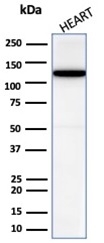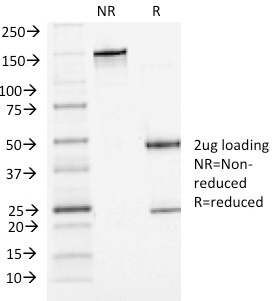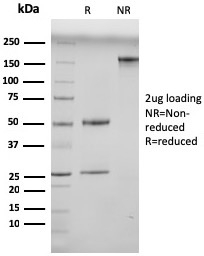

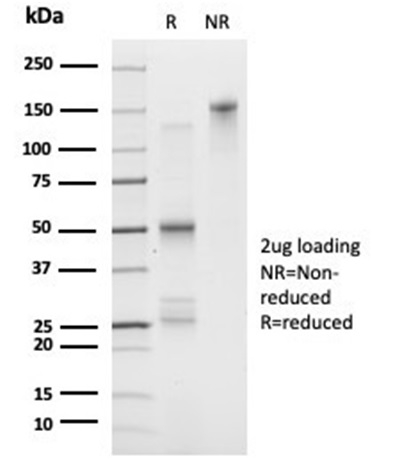
SDS-PAGE Analysis of Purified FOXI1 Mouse Monoclonal Antibody (PCRP-FOXI1-1F8). Confirmation of Purity and Integrity of Antibody.
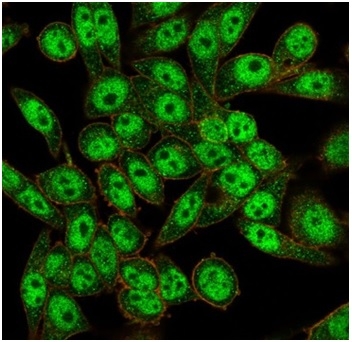
Immunofluorescence analysis of PFA-fixed HeLa cells. FOXI1 Mouse Monoclonal Antibody (PCRP-FOXI1-1F8) followed by goat anti-mouse IgG-CF488 (green). CF640A phalloidin (red).

Flow cytometric analysis of PFA-fixed HeLa cells. FOXI1 Mouse Monoclonal Antibody (PCRP-FOXI1-1F8) followed by goat anti-mouse IgG-CF488 (blue), unstained cells (red).

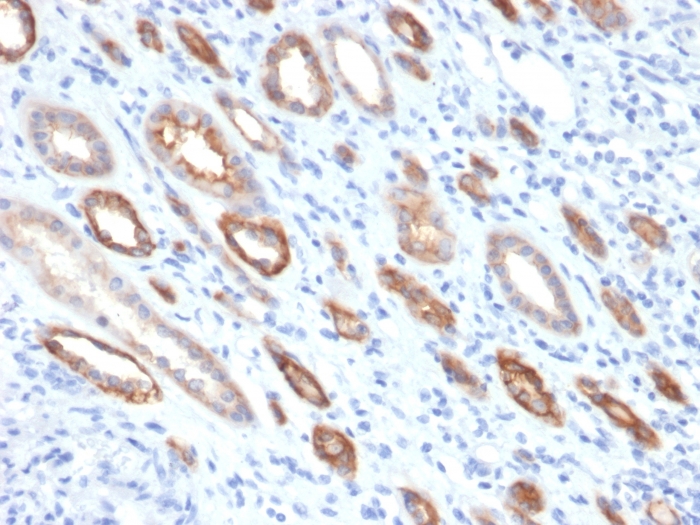
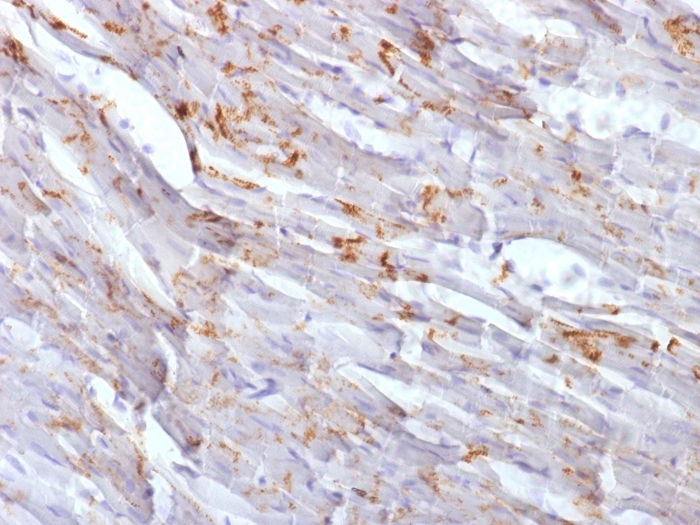
Formalin-fixed, paraffin-embedded human prostate stained. FOXI1 Mouse Monoclonal Antibody (PCRP-FOXI1-1F8) at 2ug/ml. HIER: Tris/EDTA, pH9.0, 45min. 2 °: HRP-polymer, 30min. DAB, 5min.
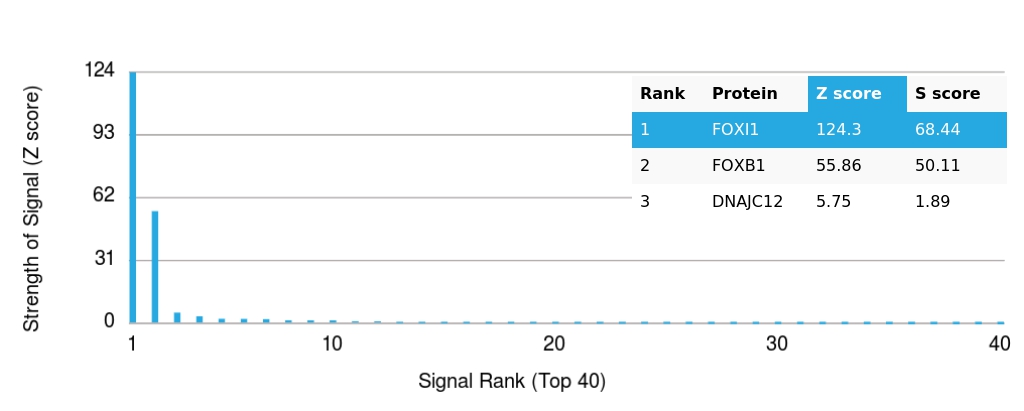
Analysis of Protein Array containing more than 19,000 full-length human proteins using FOXI1 Mouse Monoclonal Antibody (PCRP-FOXI1-1F8). Z- and S- Score: The Z-score represents the strength of a signal that a monoclonal antibody (MAb) (in combination with a fluorescently-tagged anti-IgG secondary antibody) produces when binding to a particular protein on the HuProtTM array. Z-scores are described in units of standard deviations (SD's) above the mean value of all signals generated on that array. If targets on HuProtTM are arranged in descending order of the Z-score, the S-score is the difference (also in units of SD's) between the Z-score. S-score therefore represents the relative target specificity of a MAb to its intended target. A MAb is considered to specific to its intended target, if the MAb has an S-score of at least 2.5. For example, if a MAb binds to protein X with a Z-score of 43 and to protein Y with a Z-score of 14, then the S-score for the binding of that MAb to protein X is equal to 29.
FOXI1 (forkhead box I1), also known as HFH3 (HNF-3/forkhead homolog 3), FKHL10 or FREAC6 (forkhead related transcription factor 6), is a member of the FOX family of transcription factors. The FOX family is a large group of proteins (consisting of at least 43 members) that share a common DNA binding domain termed winged-helix or forkhead domain. FOX transcription factors play important roles in development, differentiation, aging and hormone responsiveness. Localizing to the nucleus, FOXI1 functions as a transcription factor. Mice with mutated forms of FOXI1 show defects in ear development, implying that FOXI1 plays a significant role in the developmental pathway of ears and, in particular, the cochlea and vestibulum. FOXI1 is an upstream transcription regulator of Pendrin (a protein associated with deafness), suggesting a role for FOXI1 in the pathogenesis of Pendred syndrome (PS), a condition of nonsyndromic hearing loss and enlarged vestibular aqueduct (EVA).
There are no reviews yet.