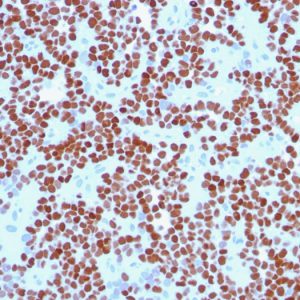
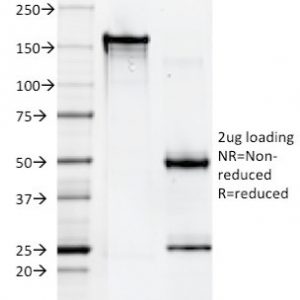
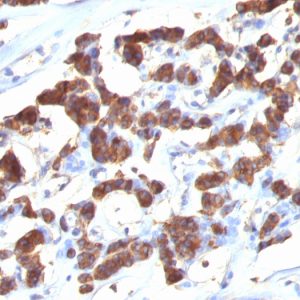
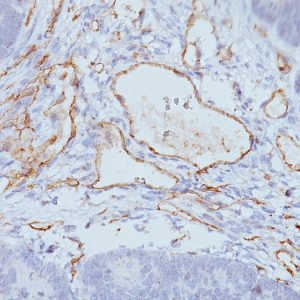
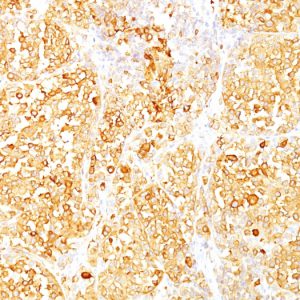
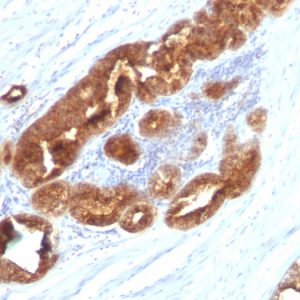
Recombinant Ubiquitin (Autophagy Marker) Antibody [rFPM1]

In Stock
Catalog Number Formulation Size Price
7314-MSM10-P0
Purified Ab with BSA and Azide at 200ug/ml
20ug
$249.00
7314-MSM10-P1
Purified Ab with BSA and Azide at 200ug/ml
100ug
$539.00
7314-MSM10-P1ABX
Purified Ab WITHOUT BSA and Azide at 1.0mg/ml
100ug
$539.00
Flat Rate Domestic: $95 | Orders outside the US - Contact Us for Order Information | Ships next business day

Applications & Dilutions

Applications Tested Dillution Protocol Note
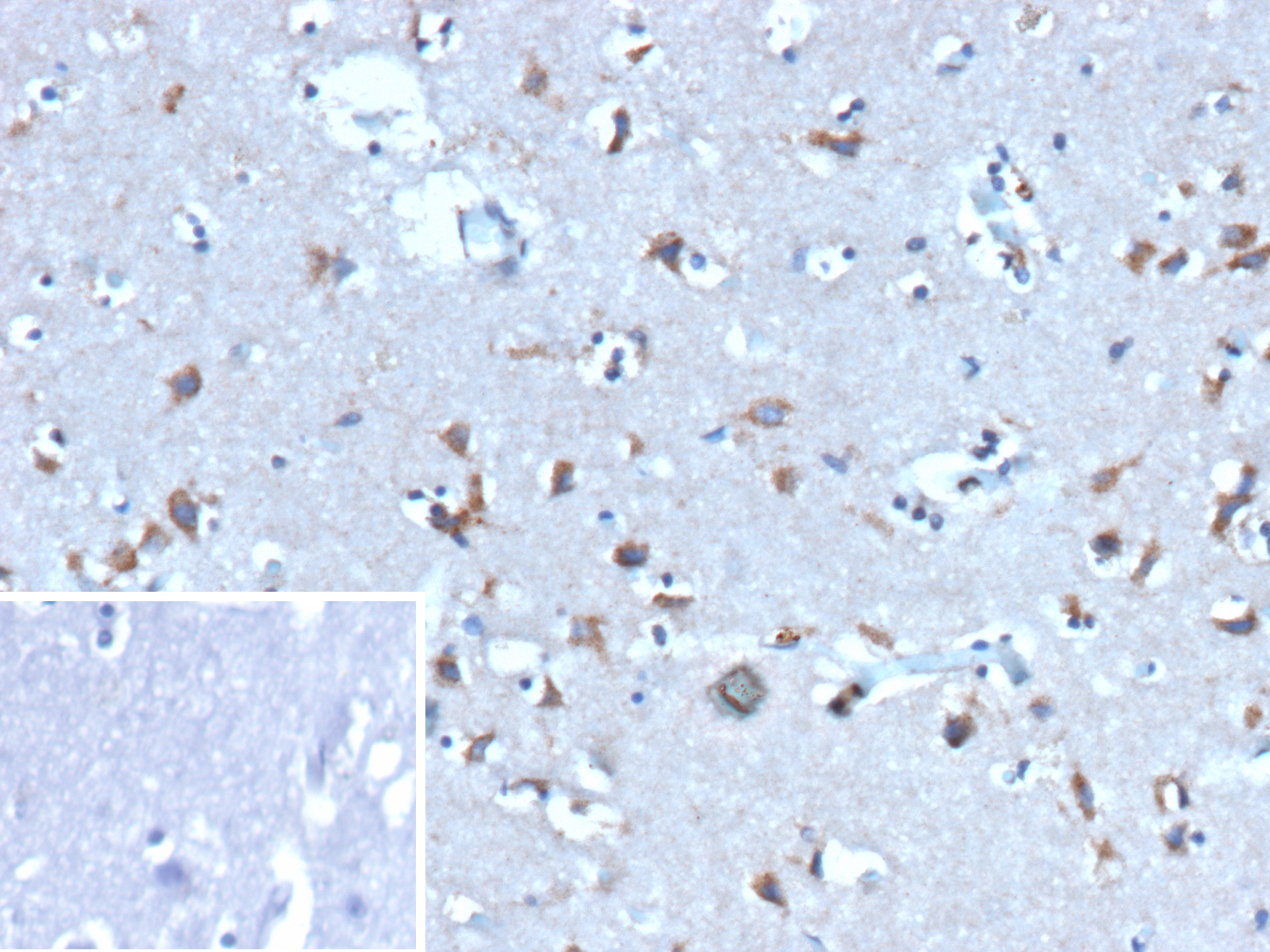
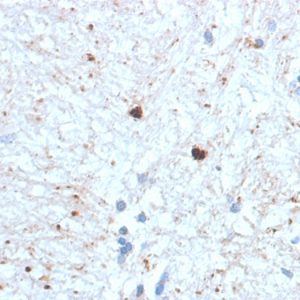
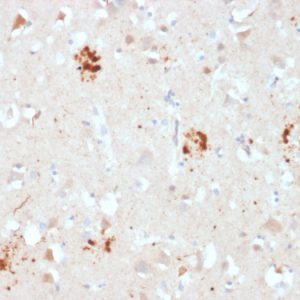
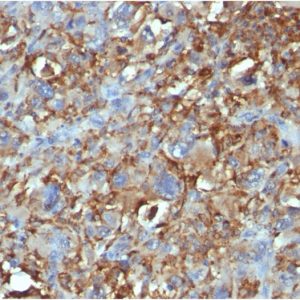
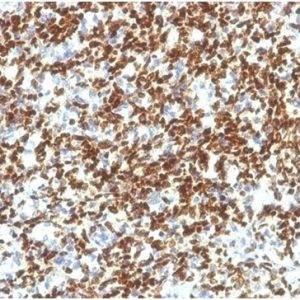
Immunohistochemistry (IHC)
1-2ug/ml
30 min at RT. Staining of formalin-fixed tissues requires heating tissue sections in 10mM Tris with 1mM EDTA, pH 9.0, for 45 min at 95°C followed by cooling at RT for 20 minutes

Summary

Ubiquitin, a small protein consisting of 76 amino acids, has been found in all eukaryotic cells studied. It is one of the most conserved proteins known. Ubiquitin is required for ATP-dependent, nonlysosomal intracellular protein degradation, which eliminates most intracellular defective proteins as well as normal proteins with a rapid turnover. Degradation involves covalent binding of ubiquitin to the protein to be degraded and it is believed that in this way ubiquitin acts to label the protein for disposal by intracellular proteases. The most abundant ubiquitin-protein conjugate, however, is ubiquitin-histone H2A. This conjugate is not degraded. Since such ubiquitinated histones are present primarily in actively transcribed chromosomal regions, ubiquitin may play a role in regulation of gene expression.

Product Properties & Targets

Host
Mouse
Applications
Species Reactivity
Isotype / Light Chain
IgG1 / Kappa
Cellular Localization
Cell membrane, Secreted
Gene Name
UBB
Positive Control
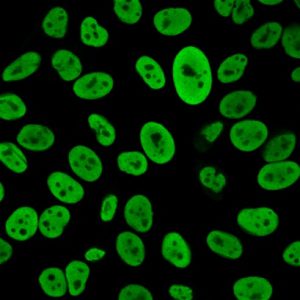
HeLa or Raji cells. Human brain.
Immunogen
Ubiquitin conjugated with glutaraldehyde crosslinked to keyhole limpet hemocyanin (KLH).
Alternate Names
Polyubiquitin-B, Ubiquitin B, Epididymis secretory protein Li 50; Polyubiquitin B; RPS27A; UBA52; UBA80; UBB; UBC; UBCEP1; UBCEP2; Ubiquitin; Ubiquitin B

Database Links

Entrez Gene ID
SwissProt

Additional Information

Clone
rFPM1
Chromosome Location
17p11.2
Mol. Weight of Antigen
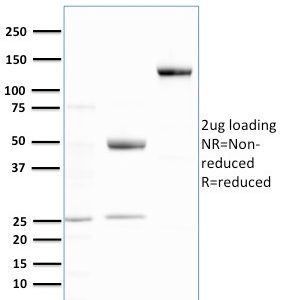
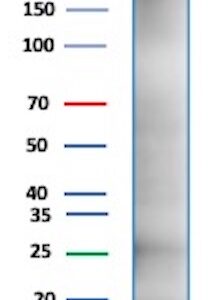
9kDa
Expression System
CHO Cells

Functions

  • Exists either covalently attached to another protein, or free (unanchored). When covalently bound, it is conjugated to target proteins via an isopeptide bond either as a monomer (monoubiquitin), a polymer linked via different Lys residues of the ubiquitin (polyubiquitin chains) or a linear polymer linked via the initiator Met of the ubiquitin (linear polyubiquitin chains). Polyubiquitin chains, when attached to a target protein, have different functions depending on the Lys residue of the ubiquitin that is linked: Lys-6-linked may be involved in DNA repair; Lys-11-linked is involved in ERAD (endoplasmic reticulum-associated degradation) and in cell-cycle regulation; Lys-29-linked is involved in proteotoxic stress response and cell cycle; Lys-33-linked is involved in kinase modification; Lys-48-linked is involved in protein degradation via the proteasome; Lys-63-linked is involved in endocytosis, DNA-damage responses as well as in signaling processes leading to activation of the transcription factor NF-kappa-B. Linear polymer chains formed via attachment by the initiator Met lead to cell signaling. Ubiquitin is usually conjugated to Lys residues of target proteins, however, in rare cases, conjugation to Cys or Ser residues has been observed. When polyubiquitin is free (unanchored-polyubiquitin), it also has distinct roles, such as in activation of protein kinases, and in signaling.

Key References

  • Sikora, Jakub et al. “Neurolysosomal pathology in human prosaposin deficiency suggests essential neurotrophic function of prosaposin.” Acta neuropathologica vol. 113,2 (2007): 163-75. doi:10.1007/s00401-006-0148-7
  • Bais, B., Kubat, B., Motazedi, E., & Verdijk, R. M. (2015). β-Amyloid Precursor Protein and Ubiquitin Immunohistochemistry Aid in the Evaluation of Infant Autopsy Eyes With Abusive Head Trauma. American journal of ophthalmology, 160(6), 1285–1295.e6. https://doi.org/10.1016/j.ajo.2015.09.005
  • Hochstrasser, M. 1995. Ubiquitin, proteasomes and the regulation of intracellular protein degradation. Curr. Opin. Cell Biol. 7: 215-223.
  • Chetty, Runjan, Kumarasen Cooper, and Allen M. Gown, editors. “Ubiquitin.” Leong’s Manual of Diagnostic Antibodies for Immunohistology. Cambridge: Cambridge University Press, 2016. 465–466. Print.

Storage & Stability

Antibody with azide - store at 2 to 8°C. Antibody without azide - store at -20 to -80°C. Antibody is stable for 24 months. Non-hazardous. No MSDS required.

Limitations

This antibody is available for research use only and is not approved for use in diagnosis.

Supplied as

200ug/ml of Ab Purified from Bioreactor Concentrate by Protein A/G. Prepared in 10mM PBS with 0.05% BSA & 0.05% azide. Also available WITHOUT BSA & azide at 1.0mg/ml.

Warranty

There are no warranties, expressed or implied, which extend beyond this description. Company is not liable for any personal injury or economic loss resulting from this product.

Reviews

There are no reviews yet.

Be the first to review “Recombinant Ubiquitin (Autophagy Marker) Antibody”

Your email address will not be published. Required fields are marked *

PARTNERSHIP OPPORTUNITIES

NeoBiotechnologies holds Exclusive rights to 10,000 recombinant and hybridoma antibody products, available for Licensing or Collaboration.

LETS TALK