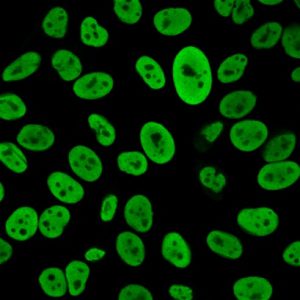
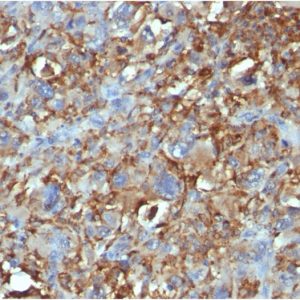
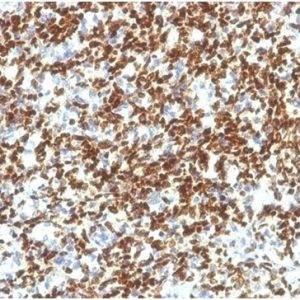
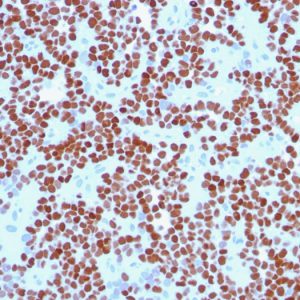
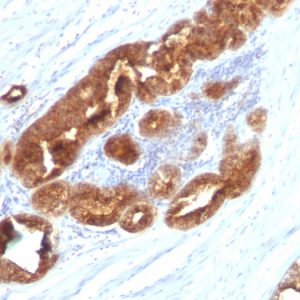
Tyrosine-protein kinase BTK Antibody [BTK/13115]

In Stock
Catalog Number Formulation Size Price
695-MSM1-P0
Purified Ab with BSA and Azide at 200ug/ml
20ug
$259.00
695-MSM1-P1
Purified Ab with BSA and Azide at 200ug/ml
100ug
$559.00
695-MSM1-P1ABX
Purified Ab WITHOUT BSA or Azide at 1.0mg/ml
100ug
$559.00
Flat Rate Domestic: $95 | Orders outside the US - Contact Us for Order Information | Ships next business day

Applications & Dilutions

Applications Tested Dillution Protocol Note
Immunohistochemistry (IHC)
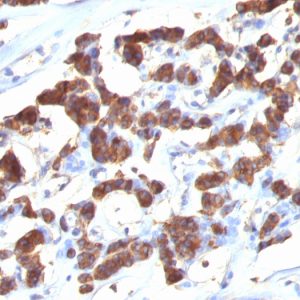
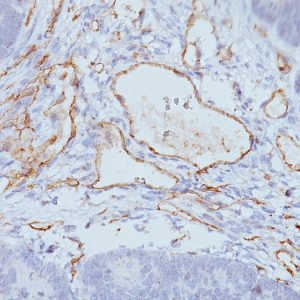
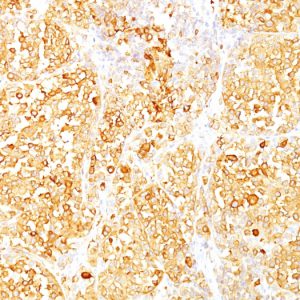
1-2ug/ml
30 min at RT. Staining of formalin-fixed tissues requires heating tissue sections in 10mM Tris with 1mM EDTA, pH 9.0, for 45 min at 95°C followed by cooling at RT for 20 minutes
Western Blot (WB)
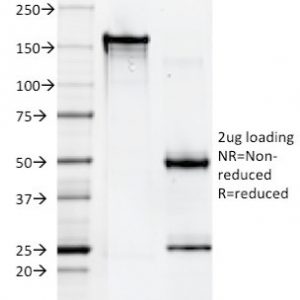
2-4ug/ml

Summary

Non-receptor tyrosine kinase indispensable for B lymphocyte development, differentiation and signaling (PubMed:19290921). Binding of antigen to the B-cell antigen receptor (BCR) triggers signaling that ultimately leads to B-cell activation (PubMed:19290921). After BCR engagement and activation at the plasma membrane, phosphorylates PLCG2 at several sites, igniting the downstream signaling pathway through calcium mobilization, followed by activation of the protein kinase C (PKC) family members (PubMed:11606584). PLCG2 phosphorylation is performed in close cooperation with the adapter protein B-cell linker protein BLNK (PubMed:11606584). BTK acts as a platform to bring together a diverse array of signaling proteins and is implicated in cytokine receptor signaling pathways (PubMed:16517732, PubMed:17932028). Plays an important role in the function of immune cells of innate as well as adaptive immunity, as a component of the Toll-like receptors (TLR) pathway (PubMed:16517732). The TLR pathway acts as a primary surveillance system for the detection of pathogens and are crucial to the activation of host defense (PubMed:16517732). Especially, is a critical molecule in regulating TLR9 activation in splenic B-cells (PubMed:16517732, PubMed:17932028). Within the TLR pathway, induces tyrosine phosphorylation of TIRAP which leads to TIRAP degradation (PubMed:16415872). BTK also plays a critical role in transcription regulation (PubMed:19290921). Induces the activity of NF-kappa-B, which is involved in regulating the expression of hundreds of genes (PubMed:19290921). BTK is involved on the signaling pathway linking TLR8 and TLR9 to NF-kappa-B (PubMed:19290921). Acts as an activator of NLRP3 inflammasome assembly by mediating phosphorylation of NLRP3 (PubMed:34554188). Transiently phosphorylates transcription factor GTF2I on tyrosine residues in response to BCR (PubMed:9012831). GTF2I then translocates to the nucleus to bind regulatory enhancer elements to modulate gene expression (PubMed:9012831). ARID3A and NFAT are other transcriptional target of BTK (PubMed:16738337). BTK is required for the formation of functional ARID3A DNA-binding complexes (PubMed:16738337). There is however no evidence that BTK itself binds directly to DNA (PubMed:16738337). BTK has a dual role in the regulation of apoptosis (PubMed:9751072). Plays a role in STING1-mediated induction of type I interferon (IFN) response by phosphorylating DDX41 (PubMed:25704810).

Product Properties & Targets

Antibody Type
Host
Mouse
Species Reactivity
Isotype / Light Chain
IgG2b / Kappa
Cellular Localization
Cell membrane, Cytoplasm, Membrane raft, Nucleus
Gene Name
BTK
Positive Control
Predominantly expressed in B-lymphocytes
Immunogen
Recombinant human BTK protein
Alternate Names
Tyrosine-protein kinase BTK, AGMX1|AT|ATK|BPK|IGHD3|IMD1|PSCTK1|XLA

Database Links

Entrez Gene ID
695
SwissProt

Additional Information

Clone
BTK/13115
Chromosome Location
Xq22.1
Mol. Weight of Antigen
76.28kDa
Purification
Protein G

Functions

  • Non-receptor tyrosine kinase indispensable for B lymphocyte development, differentiation and signaling (PubMed:19290921). Binding of antigen to the B-cell antigen receptor (BCR) triggers signaling that ultimately leads to B-cell activation (PubMed:19290921). After BCR engagement and activation at the plasma membrane, phosphorylates PLCG2 at several sites, igniting the downstream signaling pathway through calcium mobilization, followed by activation of the protein kinase C (PKC) family members (PubMed:11606584). PLCG2 phosphorylation is performed in close cooperation with the adapter protein B-cell linker protein BLNK (PubMed:11606584). BTK acts as a platform to bring together a diverse array of signaling proteins and is implicated in cytokine receptor signaling pathways (PubMed:16517732, PubMed:17932028). Plays an important role in the function of immune cells of innate as well as adaptive immunity, as a component of the Toll-like receptors (TLR) pathway (PubMed:16517732). The TLR pathway acts as a primary surveillance system for the detection of pathogens and are crucial to the activation of host defense (PubMed:16517732). Especially, is a critical molecule in regulating TLR9 activation in splenic B-cells (PubMed:16517732, PubMed:17932028). Within the TLR pathway, induces tyrosine phosphorylation of TIRAP which leads to TIRAP degradation (PubMed:16415872). BTK also plays a critical role in transcription regulation (PubMed:19290921). Induces the activity of NF-kappa-B, which is involved in regulating the expression of hundreds of genes (PubMed:19290921). BTK is involved on the signaling pathway linking TLR8 and TLR9 to NF-kappa-B (PubMed:19290921). Acts as an activator of NLRP3 inflammasome assembly by mediating phosphorylation of NLRP3 (PubMed:34554188). Transiently phosphorylates transcription factor GTF2I on tyrosine residues in response to BCR (PubMed:9012831). GTF2I then translocates to the nucleus to bind regulatory enhancer elements to modulate gene expression (PubMed:9012831). ARID3A and NFAT are other transcriptional target of BTK (PubMed:16738337). BTK is required for the formation of functional ARID3A DNA-binding complexes (PubMed:16738337). There is however no evidence that BTK itself binds directly to DNA (PubMed:16738337). BTK has a dual role in the regulation of apoptosis (PubMed:9751072). Plays a role in STING1-mediated induction of type I interferon (IFN) response by phosphorylating DDX41 (PubMed:25704810).

Storage & Stability

Antibody with azide - store at 2 to 8 °C. Antibody without azide - store at -20 to -80 °C. Antibody is stable for 24 months. Non-hazardous. No MSDS required.

Limitations

This antibody is available for research use only and is not approved for use in diagnosis.

Supplied as

200ug/ml of Ab purified from Bioreactor Concentrate by Protein G. Prepared in 10mM PBS with 0.05% BSA & 0.05% azide. Also available WITHOUT BSA & azide at 1.0mg/ml.

Warranty

There are no warranties, expressed or implied, which extend beyond this description. Company is not liable for any personal injury or economic loss resulting from this product.
PARTNERSHIP OPPORTUNITIES

NeoBiotechnologies holds Exclusive rights to 10,000 recombinant and hybridoma antibody products, available for Licensing or Collaboration.

LETS TALK