
PARTNERSHIP OPPORTUNITIES

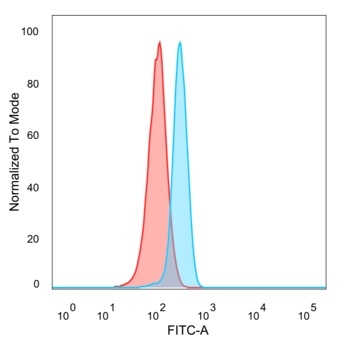
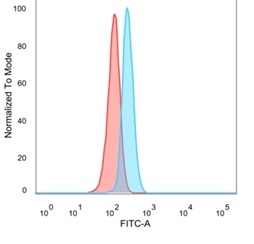
Flow cytometric analysis of PFA-fixed HeLa cells. NEUROD2 Mouse Monoclonal Antibody (PCRP-NEUROD2-1G1) followed by goat anti-mouse IgG-CF488 (blue); isotype control (red).

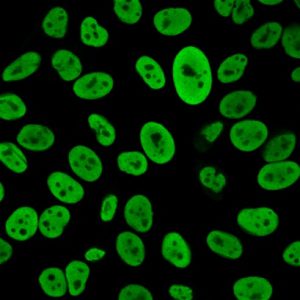
Immunofluorescence Analysis of PFA-fixed HeLa cells stained using NEUROD2 Mouse Monoclonal Antibody (PCRP-NEUROD2-1G1) followed by goat anti-mouse IgG-CF488 (green). CF640A phalloidin (red).

Immunofluorescence Analysis of PFA-fixed HeLa cells stained using NEUROD2 Mouse Monoclonal Antibody (PCRP-NEUROD2-1G1) followed by goat anti-mouse IgG-CF488 (green). CF640A phalloidin (red).

Analysis of Protein Array containing more than 19,000 full-length human proteins using NEUROD2 Mouse Monoclonal Antibody (PCRP-NEUROD2-1G1). Z- and S- Score: The Z-score represents the strength of a signal that a monoclonal antibody (MAb) (in combination with a fluorescently-tagged anti-IgG secondary antibody) produces when binding to a particular protein on the HuProtTM array. Z-scores are described in units of standard deviations (SD's) above the mean value of all signals generated on that array. If targets on HuProtTM are arranged in descending order of the Z-score, the S-score is the difference (also in units of SD's) between the Z-score. S-score therefore represents the relative target specificity of a MAb to its intended target. A MAb is considered to specific to its intended target, if the MAb has an S-score of at least 2.5. For example, if a MAb binds to protein X with a Z-score of 43 and to protein Y with a Z-score of 14, then the S-score for the binding of that MAb to protein X is equal to 29.

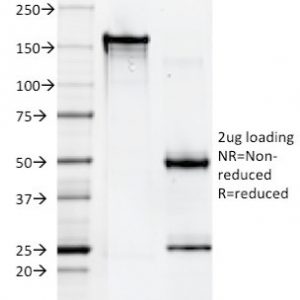
SDS-PAGE Analysis of Purified Neurogenic differentiation factor 2 Mouse Monoclonal Antibody (PCRP-NEUROD2-1G1). Confirmation of Purity and Integrity of Antibody.
Members of the myogenic determination family are basic helix-loop-helix (bHLH) proteins that can be separated into two classes, both of which work together to activate DNA transcription. Class A proteins include the ubiquitously expressed E-box binding factors, namely E2A, ITF-2 and HEB, while class B proteins, such as MyoD, myogenin and Neuro D (尾2), are transiently expressed and exhibit a much more limited tissue distribution. Working in opposition to these positively acting factors are a specialized group of basic helix-loop-helix(bHLH) transcription factorsthat function as dominant negative regulators and are involved in cell lineage determination and differentiation. Neuro D2 (neurogenic differentiation 2), also known as NDRF, NEUROD2 or bHLHa1, is a 382 amino acid nuclear protein that contains one bHLH domain and functions to induce neurogenic differentiation, playing an important role in the maintenance and determination of cell fate.


There are no reviews yet.