
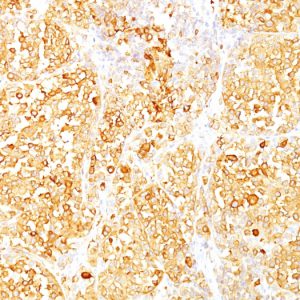
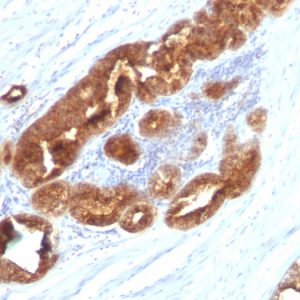
PARTNERSHIP OPPORTUNITIES

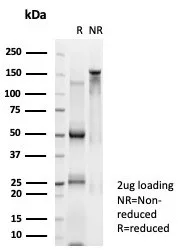
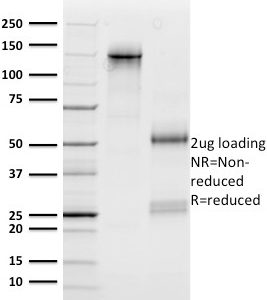
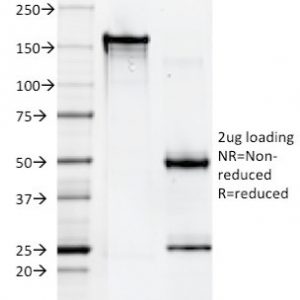
SDS-PAGE Analysis Purified n-Myc Mouse Monoclonal Antibody (PCRP-MYCN-1A9). Confirmation of Purity and Integrity of Antibody.
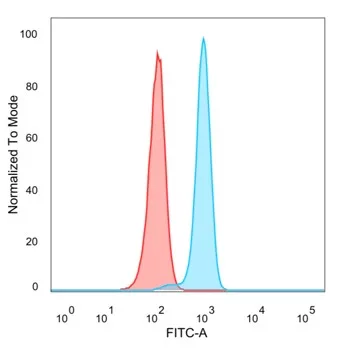
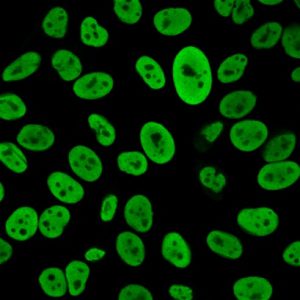
Flow cytometric analysis of PFA-fixed HeLa cells. n-Myc Mouse Monoclonal Antibody (PCRP-MYCN-1A9) followed by goat anti-mouse IgG-CF488 (blue), unstained cells (red).

Analysis of Protein Array containing more than 19,000 full-length human proteins using n-Myc Mouse Monoclonal Antibody (PCRP-MYCN-1A9). Z- and S- Score: The Z-score represents the strength of a signal that a monoclonal antibody (MAb) (in combination with a fluorescently-tagged anti-IgG secondary antibody) produces when binding to a particular protein on the HuProtTM array. Z-scores are described in units of standard deviations (SD's) above the mean value of all signals generated on that array. If targets on HuProtTM are arranged in descending order of the Z-score, the S-score is the difference (also in units of SD's) between the Z-score. S-score therefore represents the relative target specificity of a MAb to its intended target. A MAb is considered to specific to its intended target, if the MAb has an S-score of at least 2.5. For example, if a MAb binds to protein X with a Z-score of 43 and to protein Y with a Z-score of 14, then the S-score for the binding of that MAb to protein X is equal to 29.
The v-Myc oncogene, initially identified in the MC29 avian retrovirus, causes myelocytomas, carcinomas, sarcomas and lymphomas, and belongs to a family of oncogenes conserved throughout evolution. In humans, the family consists of five genes: c-Myc, N-Myc, R-Myc, L-Myc and B-Myc. Amplification of the N-Myc gene has been found in human neuroblastomas and cell lines. Its amplification correlates well with the stage of neuroblastoma disease. Immunological studies have shown that the human N-Myc gene encodes a nuclear phosphoprotein that exhibits relatively short (30 min) half life in vivo. The prototype member of the family, c-Myc p67, binds DNA in a sequence-specific manner subsequent to dimerization with a second basic region helix-loop-helix leucine zipper motif protein, designated Max.


There are no reviews yet.