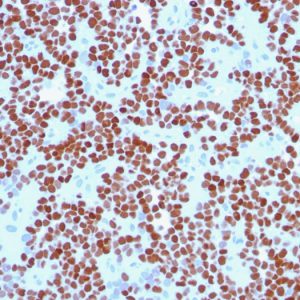
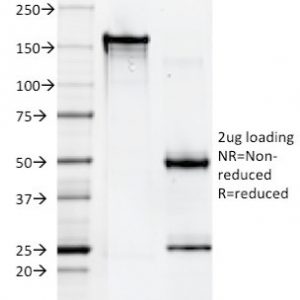
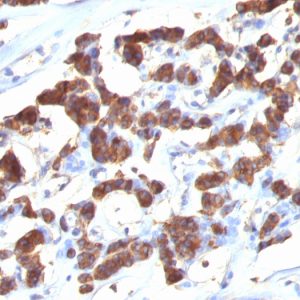
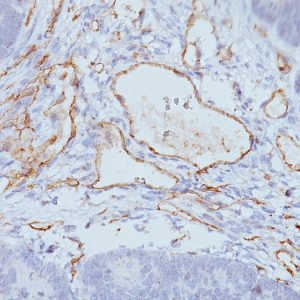
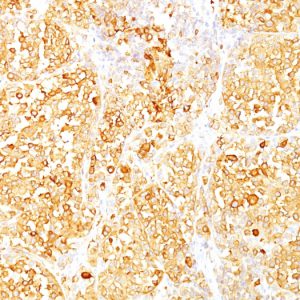
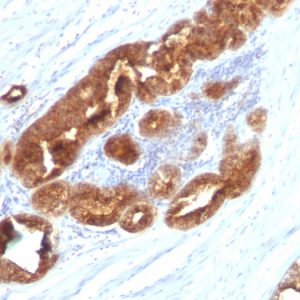
Protein deacetylase HDAC6 Antibody [PCRP-HDAC6-1D9]

In Stock
Catalog Number Formulation Size Price
10013-MSM2-P0
Purified Ab with BSA and Azide at 200ug/ml
20ug
$259.00
10013-MSM2-P1
Purified Ab with BSA and Azide at 200ug/ml
100ug
$559.00
10013-MSM2-P1ABX
Purified Ab WITHOUT BSA or Azide at 1.0mg/ml
100ug
$559.00
Flat Rate Domestic: $95 | Orders outside the US - Contact Us for Order Information | Ships next business day

Applications & Dilutions

Applications Tested Dillution Protocol
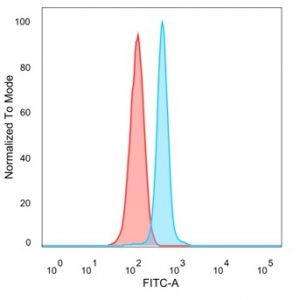
Flow Cytometry (Flow)
1-2ug/million cells
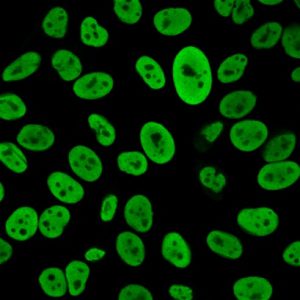
Immunofluorescence (IF)
1-3ug/ml

Summary

Deacetylates a wide range of non-histone substrates (PubMed:12024216, PubMed:18606987, PubMed:20308065, PubMed:24882211, PubMed:26246421, PubMed:30538141, PubMed:31857589, PubMed:30770470, PubMed:38534334, PubMed:39567688). Plays a central role in microtubule-dependent cell motility by mediating deacetylation of tubulin (PubMed:12024216, PubMed:20308065, PubMed:26246421). Required for cilia disassembly via deacetylation of alpha-tubulin (PubMed:17604723, PubMed:26246421). Alpha-tubulin deacetylation results in destabilization of dynamic microtubules (By similarity). Promotes deacetylation of CTTN, leading to actin polymerization, promotion of autophagosome-lysosome fusion and completion of autophagy (PubMed:30538141). Deacetylates SQSTM1 (PubMed:31857589). Deacetylates peroxiredoxins PRDX1 and PRDX2, decreasing their reducing activity (PubMed:18606987). Deacetylates antiviral protein RIGI in the presence of viral mRNAs which is required for viral RNA detection by RIGI (By similarity). Sequentially deacetylates and polyubiquitinates DNA mismatch repair protein MSH2 which leads to MSH2 degradation, reducing cellular sensitivity to DNA-damaging agents and decreasing cellular DNA mismatch repair activities (PubMed:24882211). Deacetylates DNA mismatch repair protein MLH1 which prevents recruitment of the MutL alpha complex (formed by the MLH1-PMS2 heterodimer) to the MutS alpha complex (formed by the MSH2-MSH6 heterodimer), leading to tolerance of DNA damage (PubMed:30770470). Deacetylates RHOT1/MIRO1 which blocks mitochondrial transport and mediates axon growth inhibition (By similarity). Deacetylates transcription factor SP1 which leads to increased expression of ENG, positively regulating angiogenesis (PubMed:38534334). Deacetylates KHDRBS1/SAM68 which regulates alternative splicing by inhibiting the inclusion of CD44 alternate exons (PubMed:26080397). Acts as a valine sensor by binding to valine through the primate-specific SE14 repeat region (PubMed:39567688). In valine deprivation conditions, translocates from the cytoplasm to the nucleus where it deacetylates TET2 which promotes TET2-dependent DNA demethylation, leading to DNA damage (PubMed:39567688). Promotes odontoblast differentiation following IPO7-mediated nuclear import and subsequent repression of RUNX2 expression (By similarity). In addition to its protein deacetylase activity, plays a key role in the degradation of misfolded proteins: when misfolded proteins are too abundant to be degraded by the chaperone refolding system and the ubiquitin-proteasome, mediates the transport of misfolded proteins to a cytoplasmic juxtanuclear structure called aggresome (PubMed:17846173). Probably acts as an adapter that recognizes polyubiquitinated misfolded proteins and targets them to the aggresome, facilitating their clearance by autophagy (PubMed:17846173). Involved in the MTA1-mediated epigenetic regulation of ESR1 expression in breast cancer (PubMed:24413532)., (Microbial infection) Deacetylates the SARS-CoV-2 N protein which promotes association of the viral N protein with human G3BP1, leading to disruption of cellular stress granule formation and facilitating viral replication.

Product Properties & Targets

Antibody Type
Host
Mouse
Species Reactivity
Isotype / Light Chain
IgG /
Cellular Localization
Axon, Cell projection, Centrosome, Cilium, Cilium basal body, Cytoplasm, Cytoskeleton, Dendrite, Microtubule organizing center, Nucleus, Perikaryon
Gene Name
Immunogen
Recombinant human HDAC6 protein
Alternate Names
Protein deacetylase HDAC6, CPBHM|HD6|JM21|KDAC6|PPP1R90

Database Links

Entrez Gene ID
SwissProt

Additional Information

Clone
PCRP-HDAC6-1D9
Chromosome Location
Xp11.23
Mol. Weight of Antigen
131.42kDa
Purification
Protein A

Functions

  • Deacetylates a wide range of non-histone substrates (PubMed:12024216, PubMed:18606987, PubMed:20308065, PubMed:24882211, PubMed:26246421, PubMed:30538141, PubMed:31857589, PubMed:30770470, PubMed:38534334, PubMed:39567688). Plays a central role in microtubule-dependent cell motility by mediating deacetylation of tubulin (PubMed:12024216, PubMed:20308065, PubMed:26246421). Required for cilia disassembly via deacetylation of alpha-tubulin (PubMed:17604723, PubMed:26246421). Alpha-tubulin deacetylation results in destabilization of dynamic microtubules (By similarity). Promotes deacetylation of CTTN, leading to actin polymerization, promotion of autophagosome-lysosome fusion and completion of autophagy (PubMed:30538141). Deacetylates SQSTM1 (PubMed:31857589). Deacetylates peroxiredoxins PRDX1 and PRDX2, decreasing their reducing activity (PubMed:18606987). Deacetylates antiviral protein RIGI in the presence of viral mRNAs which is required for viral RNA detection by RIGI (By similarity). Sequentially deacetylates and polyubiquitinates DNA mismatch repair protein MSH2 which leads to MSH2 degradation, reducing cellular sensitivity to DNA-damaging agents and decreasing cellular DNA mismatch repair activities (PubMed:24882211). Deacetylates DNA mismatch repair protein MLH1 which prevents recruitment of the MutL alpha complex (formed by the MLH1-PMS2 heterodimer) to the MutS alpha complex (formed by the MSH2-MSH6 heterodimer), leading to tolerance of DNA damage (PubMed:30770470). Deacetylates RHOT1/MIRO1 which blocks mitochondrial transport and mediates axon growth inhibition (By similarity). Deacetylates transcription factor SP1 which leads to increased expression of ENG, positively regulating angiogenesis (PubMed:38534334). Deacetylates KHDRBS1/SAM68 which regulates alternative splicing by inhibiting the inclusion of CD44 alternate exons (PubMed:26080397). Acts as a valine sensor by binding to valine through the primate-specific SE14 repeat region (PubMed:39567688). In valine deprivation conditions, translocates from the cytoplasm to the nucleus where it deacetylates TET2 which promotes TET2-dependent DNA demethylation, leading to DNA damage (PubMed:39567688). Promotes odontoblast differentiation following IPO7-mediated nuclear import and subsequent repression of RUNX2 expression (By similarity). In addition to its protein deacetylase activity, plays a key role in the degradation of misfolded proteins: when misfolded proteins are too abundant to be degraded by the chaperone refolding system and the ubiquitin-proteasome, mediates the transport of misfolded proteins to a cytoplasmic juxtanuclear structure called aggresome (PubMed:17846173). Probably acts as an adapter that recognizes polyubiquitinated misfolded proteins and targets them to the aggresome, facilitating their clearance by autophagy (PubMed:17846173). Involved in the MTA1-mediated epigenetic regulation of ESR1 expression in breast cancer (PubMed:24413532)., (Microbial infection) Deacetylates the SARS-CoV-2 N protein which promotes association of the viral N protein with human G3BP1, leading to disruption of cellular stress granule formation and facilitating viral replication.

Storage & Stability

Antibody with azide - store at 2 to 8 °C. Antibody without azide - store at -20 to -80 °C. Antibody is stable for 24 months. Non-hazardous. No MSDS required.

Limitations

This antibody is available for research use only and is not approved for use in diagnosis.

Supplied as

200ug/ml of Ab purified from Bioreactor Concentrate by Protein A. Prepared in 10mM PBS with 0.05% BSA & 0.05% azide. Also available WITHOUT BSA & azide at 1.0mg/ml.

Warranty

There are no warranties, expressed or implied, which extend beyond this description. Company is not liable for any personal injury or economic loss resulting from this product.
PARTNERSHIP OPPORTUNITIES

NeoBiotechnologies holds Exclusive rights to 10,000 recombinant and hybridoma antibody products, available for Licensing or Collaboration.

LETS TALK