
PARTNERSHIP OPPORTUNITIES

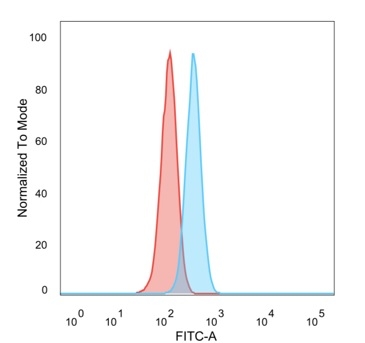
Flow Cytometric Analysis of PFA-fixed HeLa cells. ZNF622 Mouse Monoclonal Antibody (PCRP-ZNF622-1C11) followed by goat anti-mouse IgG-CF488 (blue); unstained cells (red).

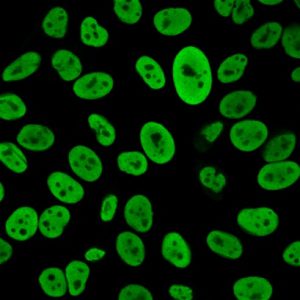
Immunofluorescence Analysis of PFA-fixed HeLa cells using ZNF622 Mouse Monoclonal Antibody (PCRP-ZNF622-1C11) followed by goat anti-mouse IgG-CF488 (green). CF640A phalloidin (red).

Analysis of Protein Array containing more than 19,000 full-length human proteins using ZNF622 Mouse Monoclonal Antibody (PCRP-ZNF622-1C11). Z- and S- Score: The Z-score represents the strength of a signal that a monoclonal antibody (MAb) (in combination with a fluorescently-tagged anti-IgG secondary antibody) produces when binding to a particular protein on the HuProtTM array. Z-scores are described in units of standard deviations (SD's) above the mean value of all signals generated on that array. If targets on HuProtTM are arranged in descending order of the Z-score, the S-score is the difference (also in units of SD's) between the Z-score. S-score therefore represents the relative target specificity of a MAb to its intended target. A MAb is considered to specific to its intended target, if the MAb has an S-score of at least 2.5. For example, if a MAb binds to protein X with a Z-score of 43 and to protein Y with a Z-score of 14, then the S-score for the binding of that MAb to protein X is equal to 29.

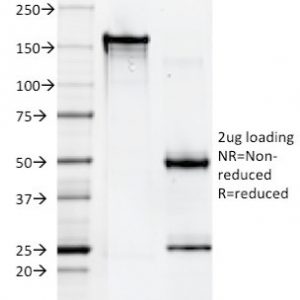
SDS-PAGE Analysis of Purified Zinc finger protein 622 Mouse Monoclonal Antibody (PCRP-ZNF622-1C11). Confirmation of Purity and Integrity of Antibody.
Zinc-finger proteins contain DNA-binding domains and have a wide variety of functions, most of which encompass some form of transcriptional activation or repression. ZNF622 (zinc-finger protein 622), also known as ZPR9 (zinc-fingerlike protein 9), is a 477 amino acid protein that localizes to both the nucleus and the cytoplasm. Expressed in liver, spleen, lung, kidney and brain, ZNF622 is thought to activate the bound transcription factor B-Myb and, through this activation, may play a role in embryonic development. ZNF622 contains two U1-type zinc fingers and exists as either a homodimer or a heterodimer that can be phosphorylated by MELK (maternal embryonic leucine zipper kinase). Overexpression of ZNF266 may be associated with liver metastases, carcinomatoses and colorectal carcinomas.


There are no reviews yet.