


PARTNERSHIP OPPORTUNITIES


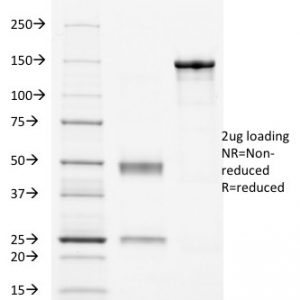
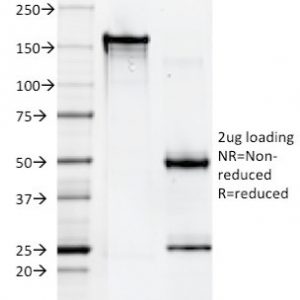
SDS-PAGE Analysis of Purified CD16 Mouse Monoclonal Antibody (C16/1045). Confirmation of Purity and Integrity of Antibody.

Flow cytometry analysis of lymphocyte-gated PBMCs unstained (gray) or stained with CF405S-labeled CD16 monoclonal antibody (C16/1045) (violet).

Western Blot Analysis of Human Liver, Human Lung and Human Spleen tissue cell lysates using CD16 Mouse Monoclonal Antibody (C16/1045).

Western Blot Analysis of Human Liver, Mouse Liver, Rat Liver, Hamster Liver, Guinea pig Liver, Rabbit Liver, Human Spleen, Mouse Spleen, Rat Spleen, Hamster Spleen, Guinea pig Spleen and Rabbit Spleen tissue cell lysates using CD16 Mouse Monoclonal Antibody (C16/1045).
It recognizes CD16 (FcgammaRIII), the low-affinity receptor for IgG with an apparent molecular weight of 50-80kDa. Two similar genes represent CD16, CD16A (FcgammaRIIIA), which exists as a hetero-oligomeric polypeptide-anchored form in macrophages and NK cells and CD16B (FcgammaRIIIB), which exist as a monomeric GPI-anchored form in neutrophils. Furthermore, there are two known polymorphisms of CD16B, NA-1 and NA-2. Individuals homozygous for NA-2 show a lower phagocytic capacity compared with NA-1. CD16 binds IgG in the form of immune complexes and shows preferential binding of IgG1 and IgG3 isotypes and minimal binding of IgG2 and IgG4. Upon IgG binding, both CD16 isoforms initiate signal transduction cascades that lead to a variety of responses including antibody-dependent cell-mediated cytotoxicity (ADCC), phagocytosis, degranulation and proliferation.


There are no reviews yet.