PARTNERSHIP OPPORTUNITIES

28 December, 2023 by Anshul (neobio)

Finding it challenging to select the best primary antibody for western blot applications in your research? It’s a common struggle for researchers. The success of your western blotting experiment significantly relies on choosing the right primary antibodies. They are the pinpoint precision tools that detect your target protein among a complex mixture of proteins. However, with various antibody types and factors to consider, the selection process can be overwhelming.
Western blotting is a widely employed technique in biological research, instrumental in the detection and analysis of specific proteins within a sample. It separates proteins based on molecular weight, then transfers them onto a membrane for detection using antibodies. The antibodies bind specifically to their target proteins, enabling their visualization and further analysis.
The primary antibody is key in a western blotting protocol. It binds directly to the protein of interest, allowing for specific detection amidst other proteins. Antibodies bring specificity to the process, making them crucial in determining accurate and effective results. Therefore, deciding on the right primary antibody is crucial to the success of the western blot experiment.
When selecting a primary antibody for western blotting, consider factors like specificity, selectivity, and consistency of performance. Trade-offs might occur between polyclonal, monoclonal, and recombinant antibodies. For example, while monoclonal antibodies offer lot-to-lot consistency, they may be less sensitive than polyclonal antibodies. Recombinant antibodies provide stability and control over production but may come at a higher price.
Informed decision-making can lead you to the right antibody for your specific requirements, reducing variability and increasing result reliability.
| Type | Advantage | Disadvantage |
|---|---|---|
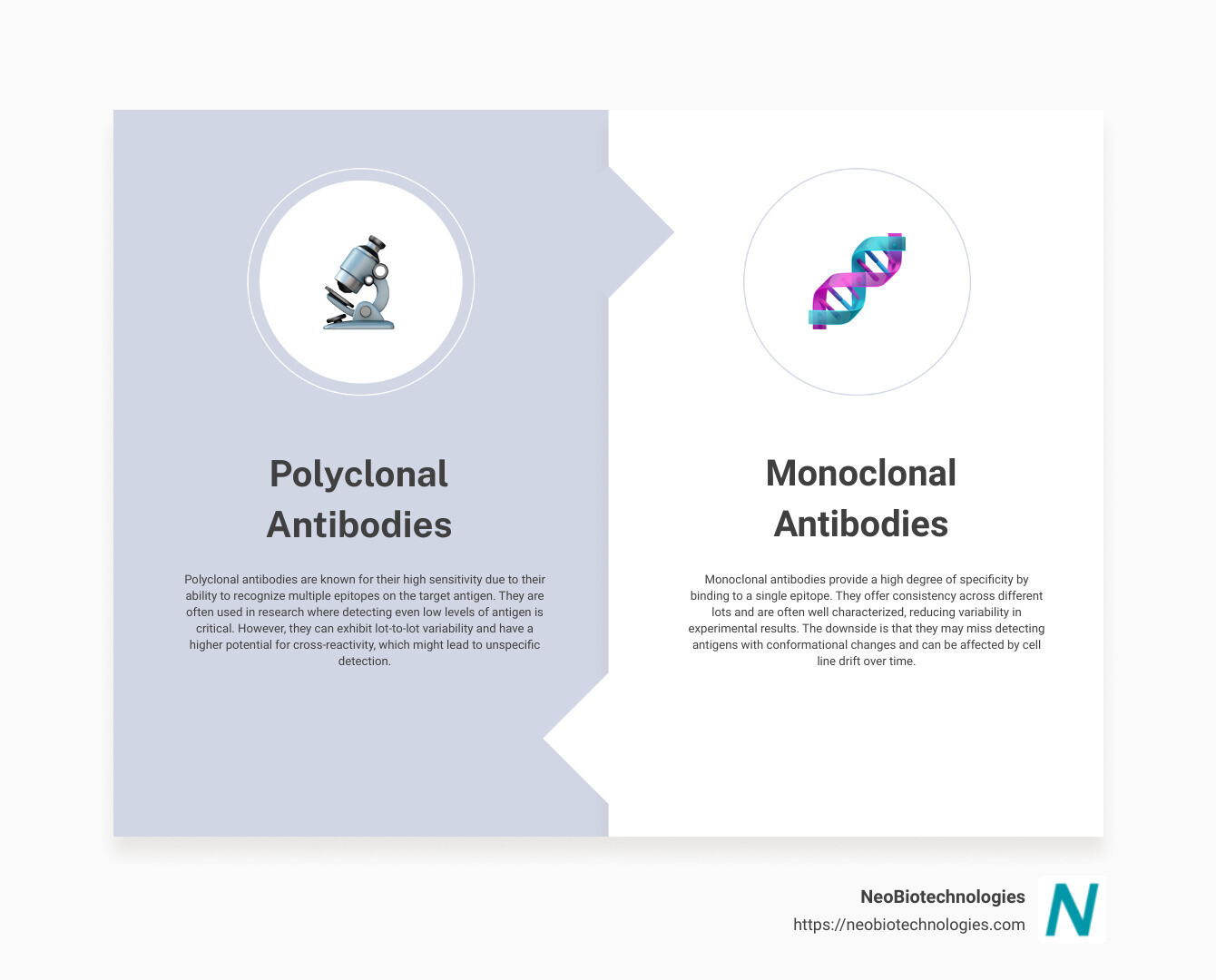
| Polyclonal | Highly sensitive, recognizes multiple epitopes | Lot-to-lot variability, potential for unspecific detection |
| Monoclonal | Consistent, often well characterized | Dependent on single epitope, potential for cell line drift |
| Recombinant | Stable, not susceptible to cell-line drift | Higher price, needs upfront optimization |
As you read further, you’ll discover the top five primary antibodies for western blotting from NeoBiotechnologies. These products stand out, offering excellent specificity, selectivity, and reliable performance, making your protein detection tasks more accurate and less burdensome.
Primary antibodies play a crucial role in Western blotting, a technique used to detect specific proteins in a sample. The primary antibodies are uniquely designed to bind to the target protein, helping scientists identify and quantify it. The choice of a primary antibody can significantly influence the quality of your Western blot results, making it crucial to understand their role, types, and factors affecting their performance.
Primary antibodies are a type of protein that recognizes and binds to a specific antigen or target protein in a sample. In the context of a primary antibody western blot, these antibodies are used to detect the protein of interest. After the protein sample undergoes separation by gel electrophoresis and transfer to a membrane, the primary antibody is added. The antibody binds specifically to the protein of interest, enabling its detection and quantification.
Primary antibodies can be categorized into three types: polyclonal, monoclonal, and recombinant. Each type has its advantages and disadvantages, as explained by our expert, Dr. Atul K. Tandon, Founder and CEO of NeoBiotechnologies.
Polyclonal antibodies are produced from different B cells and recognize multiple epitopes on the same antigen. This makes them highly sensitive, but they may also exhibit lot-to-lot variability, which can cause inconsistent results.
Monoclonal antibodies, on the other hand, are produced by identical B cell clones and recognize a single epitope on the antigen. They offer lot-to-lot consistency and are highly specific, but their sensitivity is dependent on the abundance and exposure of a single epitope.
Recombinant antibodies are derived from recombinant DNA and can be modified on the DNA level. They offer stable, long-term supply with lot-to-lot consistency, but they can be more specialized and epitope dependent, possibly requiring more optimization.
Antibody specificity, or the ability to recognize and bind to its target antigen, is crucial for robust and reproducible research. But it’s important to note that antibody specificity and selectivity can be highly dependent on the particular assay context and can be influenced by the type of immunogen used to produce the antibody.
For example, antibodies generated using peptides can be useful for western blotting as target proteins have linearized epitopes due to denaturation and reduction during sample processing. However, antibodies generated against native proteins may not recognize the linearized epitopes of the denatured proteins in western blotting.
To ensure reproducible results, it is important to evaluate antibodies within the intended assays and experimental contexts. This is where antibody validation comes into play. It confirms that the primary antibody is specific for its target antigen and selectively binds its target in the presence of other antigens. Validation provides experimental proof that an antibody is suitable for the intended assay or purpose, ensuring specificity, selectivity, and reproducibility. At NeoBiotechnologies, a key aspect of our product development process is a thorough antibody validation for all our primary antibodies.
In the next section, we will dive deeper into the portfolio of primary antibodies offered by NeoBiotechnologies and how they stand out from other products in the market.
NeoBiotechnologies is a premier manufacturer of over 1,000 highly validated and monospecific Rabbit Recombinant Monoclonal Antibodies, ideal for various applications including Western Blotting. Not only are these antibodies produced with the highest standards of quality and specificity, but they also offer exceptional lot-to-lot consistency.
Let’s delve into the specifics of five primary antibodies that are noteworthy for Western Blotting applications.
The first primary antibody for Western Blotting is the Cyclin E Antibody. Cyclin E belongs to the highly conserved cyclin family, which plays a critical role in the temporal coordination of each mitotic event. The Cyclin E antibody is monoclonal, offering high specificity and reproducibility. It is highly sensitive and has been rigorously tested for target specificity and functional application validation, making it an ideal choice for researchers studying the cell cycle and related processes.
The second antibody is the RBM20 Antibody. RBM20, or RNA Binding Motif Protein 20, is an essential protein involved in the alternative splicing of many cardiac genes. The RBM20 antibody from NeoBiotechnologies is recombinant and monoclonal, ensuring a high degree of specificity and consistent performance across different lots. It’s a reliable choice for researchers studying heart diseases and gene expression.
Our third primary antibody for Western Blotting is the CA 19-9 Antibody. CA 19-9 is a tumor marker particularly associated with gastrointestinal cancers. This antibody is monoclonal and offers high specificity and reproducibility, making it ideal for researchers working in oncology and cancer biomarker discovery.
Next up is the PLAP Antibody, which targets the Placental Alkaline Phosphatase, a protein that is overexpressed in several types of tumors. This highly specific and reliable monoclonal antibody is a valuable tool for researchers studying cancer biology and looking for novel therapeutic targets.
Finally, we have the Immunofluorescence Monoclonal Antibody. This antibody is designed for use in immunofluorescence assays but is also excellent for Western Blotting. It’s a versatile tool for researchers studying protein expression and localization, and its monoclonal nature ensures high specificity and reproducibility.
Each of these antibodies offers unique benefits and is designed to meet the needs of researchers in different fields of study. By selecting a primary antibody for Western Blotting from NeoBiotechnologies, you can be confident in the specificity, reliability, and reproducibility of your results.
Choosing the right primary antibody for a Western blot is just the first step. To ensure optimal results, proper handling, storage, and usage of the antibodies are essential. By following some basic guidelines, you can significantly enhance the performance of your primary antibody.
The way you store and handle your primary antibodies can greatly impact their performance. It is essential to follow the manufacturer’s guidelines for primary antibody storage. Generally, primary antibodies should be aliquoted and frozen in single-use volumes to avoid multiple freeze-thaw cycles which can degrade the antibodies. Working solutions should be made up fresh on the day of intended use.
The concentration of the primary antibody can also influence the quality of your Western blot results. Too high a concentration may lead to non-specific binding, while too low a concentration may not yield a detectable signal. The optimal concentration can be determined through a process called titration, which involves testing the antibody at various dilutions to find the concentration that provides the best signal-to-noise ratio.
The incubation period and conditions are also critical factors. Typically, the membrane is incubated with the primary antibody at room temperature for about an hour. However, an overnight incubation at 4°C may also be effective. It’s crucial to follow the manufacturer’s instructions for the best results.
In some cases, you might want to probe the same membrane with a second pair of antibodies. This is possible but requires careful handling to avoid damaging the membrane or losing signal. The process involves stripping the first pair of antibodies off the membrane and then re-blocking and re-probing with the second pair.
When optimizing the use of primary antibodies in Western blotting, it is essential to remember that each antibody and protein pair may require a unique experimental setup. Therefore, validation for each pair under the specific experimental conditions is recommended.
By carefully selecting and optimizing your primary antibodies for Western blotting, you can significantly improve the quality and reproducibility of your results, allowing for more accurate and reliable data analysis.
We have reviewed the top five primary antibodies for western blotting from the portfolio of NeoBiotechnologies. These antibodies, meticulously developed and highly validated, are designed to offer high specificity, affinity, and reproducibility in your Western blotting applications.
Each primary antibody offers unique features and advantages, making them ideal for different use cases. The suitability of a particular primary antibody for your experimental setup depends on factors such as the target protein, the host species of the antibody, and the specific requirements of your experiment.
Choosing the right primary antibodies for Western blotting is a critical step in ensuring the success of your experiments. It affects not only the sensitivity and specificity of your protein detection, but also the reproducibility of your results. As such, it is vital to invest time and effort in selecting the most appropriate antibodies and validating their performance under your specific experimental conditions.
While this process can be challenging, the comprehensive range of primary antibodies offered by NeoBiotechnologies can significantly simplify your task. With their stringent quality control and thorough validation procedures, you can trust these antibodies to deliver consistent and reliable results in your Western blotting experiments.
Remember that the performance of a primary antibody can be influenced by various experimental factors, including the amount of sample loaded, Western blotting conditions, and detection/visualization methods. Therefore, it is recommended to optimize these parameters for each primary antibody and experimental setup.
In conclusion, the right primary antibodies can make a significant difference to the success of your Western blotting experiments. With careful selection and optimization, you can achieve accurate and reliable results that contribute to the advancement of scientific knowledge.
For further reading, you can check out more about monoclonal antibodies and polyclonal antibodies on the NeoBiotechnologies website.


