PARTNERSHIP OPPORTUNITIES

02 December, 2023 by Anshul (neobio)

Monoclonal antibodies play a vital role in biomedical research. They are veritable workhorses in laboratory procedures, used extensively in applications ranging from cell sorting to immunofluorescence. However, their efficacy hinges heavily on a crucial factor: validation. You might be wondering how to validate monoclonal antibodies and ensure they are fit for your specific needs. Dr. Atul K. Tandon, our founder and CEO at NeoBiotechnologies, calls these critical processes the “Wild West of the biological world,” underlining the need for meticulous validation.
Validation is pivotal to establish the antibody’s specificity, reproducibility, and affinity to its target proteins. Inadequate or inaccurate validation can lead to poor consistency in results, skewing research and potentially having dire implications. Unfortunately, deciphering the validation status of antibodies can be confusing, complex, and time-consuming.
Poorly validated antibodies in research can cost precious time, resources, and trust in scientific outcomes. The widespread application and the considerable operational range of antibodies further complicate the scenario. Our expert, Dr. Atul K. Tandon, believes, “In a research landscape where monoclonal antibodies are entrusted with the heaviest lifting, ensuring their validation is not optional. It’s indispensable.”
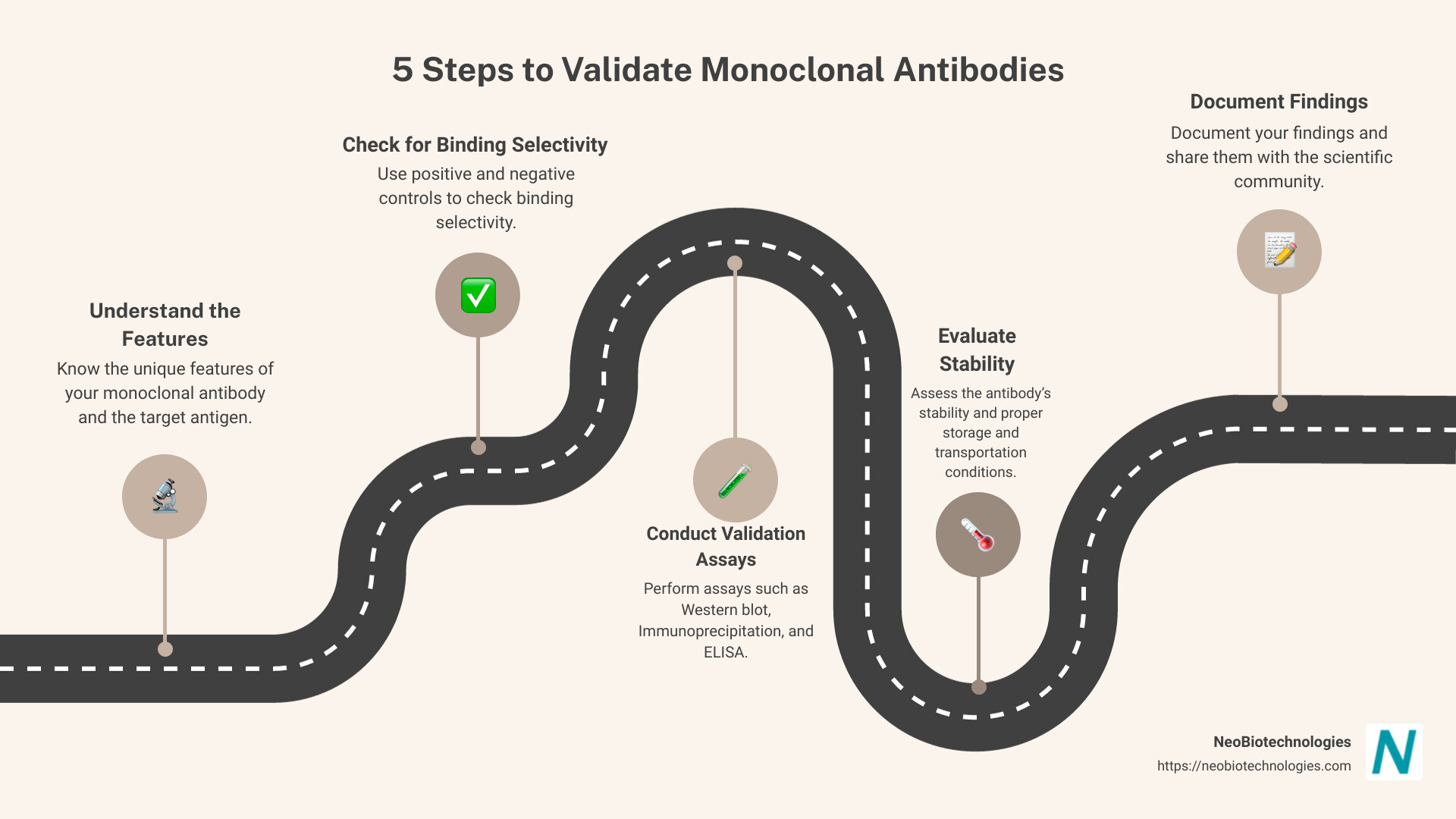
In this guide, we aim to simplify monoclonal antibody validation. We’ll provide you with five easy steps tailored from our extensive expertise at NeoBiotechnologies, so you can breeze through the process and ensure your monoclonal antibodies are reliable, specific, and fit for study.
Let’s dive into the journey of validating monoclonal antibodies!
In any research scenario, it is essential to clearly define what you are working with. Let’s start with your antibody. Monoclonal antibodies (mAbs) are a class of antibodies that are clones of a single parent cell. They are unique in their ability to bind to a single antigen – a feature that makes them incredibly valuable in scientific research.
But how do you define your specific monoclonal antibody? One of the most comprehensive ways to do this is by referring to its structure, mainly defined by the amino acid sequence. If this is not available, a clone number, commercial product number, antibody ID, or equivalent can also be used to identify an antibody in an unambiguous way (Dr. Atul K. Tandon, NeoBiotechnologies).

Knowing your antibody is only half the battle. You also need to clearly define the target – the antigen your monoclonal antibody is designed to bind to. This is essential in the process of antibody validation, as misidentification of the target can lead to incorrect observations and false conclusions in your research.
Identifying the target antigen can be as simple as stating the name of the protein or molecule your antibody is designed to bind to. However, it is equally important to specify the exact epitope (the part of the antigen recognised by the antibody) if this information is available.
In some cases, the target of an antibody may not be a single protein, but a complex of proteins or a conformational epitope. In these cases, it is crucial to identify all components of the target.

At NeoBiotechnologies, we understand the importance of clear and unambiguous identification of both antibodies and their targets. That’s why we provide extensive information on our antibodies, including their specificities and the precise antigens they are designed to bind to.
By defining your antibody and its target clearly, you’ve taken the first step in the process of how to validate monoclonal antibodies. This sets the stage for the next steps, where you’ll assess binding selectivity and perform validation assays.
In the process of validating monoclonal antibodies, assessing binding selectivity is a paramount step. This involves verifying that the antibody binds selectively to the intended target, and not to other unrelated proteins. There are several ways to assess this, but one of the most effective methods is through the use of positive and negative controls.
A well-designed experiment should include both positive and negative controls. Positive controls are samples that are known to express the target protein, while negative controls are samples that do not express the target protein. These controls play a crucial role in validating the specificity of an antibody.
The selection of appropriate positive and negative controls can be a complex process. One must consider various factors, including the cell or tissue types that express or do not express the target protein. Information about target protein expression in different tissues or cell lines can be found in peer-reviewed papers and online protein databases. However, it’s important to remember that the preparation of your test samples is crucial. For instance, if an antibody recognizes the protein only in its native form, it should not be used on samples prepared under denaturing conditions, such as western blot.
Positive and negative controls can also be designed using various methods, such as knock-out models, siRNA knockdown, and cell treatment. Genetic knock-out (KO) models are particularly powerful tools for antibody validation as they represent an absolute negative control. At NeoBiotechnologies, we are addressing the issue of antibody specificity with an ongoing KO-validation program using human KO cell lines, generated from cellular models via CRISPR/Cas9 .
In a KO model, the gene coding for the target protein is completely “knocked out,” or deleted, so the protein is not expressed at all. This provides a true negative control for antibody validation. If the antibody still shows a signal in the KO model, this indicates that the antibody may be binding non-specifically to other proteins.
siRNA knockdown and cell treatment methods, on the other hand, can be used to modulate the expression levels of the target protein, providing a useful range of controls for antibody validation.
By assessing binding selectivity using these methods, you can ensure that your antibody is specific to your target of interest. This brings us closer to the goal of understanding how to validate monoclonal antibodies. In the next step, we’ll look at how to perform validation assays.
After defining your antibody and its target as well as assessing binding selectivity, the next step in how to validate monoclonal antibodies is to perform validation assays. These assays give you concrete evidence of the performance and specificity of your antibody.
A common method used for antibody validation is a combination of immunoprecipitation (IP) and Western blotting. The target protein is first precipitated with the antibody, then detected by Western blotting with a different antibody against the same target. This dual approach provides confidence that both antibodies are binding to the correct protein.
At NeoBiotechnologies, we use this method extensively in our antibody validation to ensure the highest level of specificity and performance. It is a reliable and robust method to verify that our antibodies are binding to the correct protein with high specificity.
In addition to Western blotting and IP, other techniques are also used in the validation process. These include immunohistochemistry (IHC), immunofluorescence (IF), and enzyme-linked immunosorbent assay (ELISA).
IHC and IF are valuable tools for visualizing the location of the target protein in the cell or tissue. These methods can confirm that the antibody binds to the protein in its native environment, and that the protein is present in the expected cellular compartment.
ELISA, on the other hand, is a powerful technique for quantifying the amount of target protein. By comparing the signal from the test antibody with that of a control, you can determine the sensitivity and specificity of your antibody.
At NeoBiotechnologies, we validate our monospecific Rabbit Recombinant Monoclonal Antibodies using these techniques. This helps to ensure that our products meet the high standards required by the world’s top institutions and researchers.
By following these steps, you can validate your monoclonal antibodies effectively. Remember that the validation process does not end with these assays. It is important to also evaluate the stability and storage protocols of your antibodies, which is what we will discuss in the next section.
In the journey of understanding how to validate monoclonal antibodies, the fourth step involves evaluating the stability and storage protocols of the antibodies. The way antibodies are stored and transported can greatly impact their performance.
Just like any other bioactive substances, monoclonal antibodies can be quite sensitive to environmental conditions such as temperature, humidity, and pH. Therefore, proper storage and transport are crucial to maintaining their integrity and performance.
Antibodies, if not properly stored, can denature and lose their ability to bind to their target antigen. Some antibodies may require refrigeration, while others may need to be frozen at very low temperatures. In addition to temperature, other factors such as pH and the presence of preservatives can also impact antibody stability.
At NeoBiotechnologies, we understand the importance of maintaining antibody stability. We provide detailed information about the optimal storage conditions for each of our antibodies to ensure their performance.
Even with the best storage and stability protocols in place, it is essential for end-users to perform secondary verification of antibody performance. This is because the performance of the antibodies can be influenced by the specifics of the experimental setup, including the assay conditions and the sample type.
We recommend end-users to perform a small-scale test under their specific experimental conditions before proceeding to large-scale experiments. This can help to ensure that the antibodies are working as expected in the specific context of their research.
Secondary verification is not only beneficial for the individual researcher, but also contributes to the larger scientific community. By sharing their experiences and results, researchers can help to build a more reliable and robust body of knowledge about the performance of specific antibodies.
In the next section, we will discuss the importance of documenting this information and sharing experiences for effective monoclonal antibody validation.
Having a system in place for collecting and analyzing user feedback is an integral part of the process of how to validate monoclonal antibodies. At NeoBiotechnologies, we believe that our users’ experiences with our products offer invaluable insights into the performance of our antibodies. These insights can help us to continually improve the quality and reliability of our products.
Feedback from users can provide important information about the real-world performance of our antibodies. Users can confirm whether an antibody works as expected in a particular application, or if it has unexpected cross-reactivity or other issues. Such feedback can also help to validate the results from initial laboratory tests, providing a form of secondary verification. Thus, we strongly encourage our users to share their experiences with our products.
Open science platforms are online platforms where scientists can share their research data, methods, and findings openly with the global scientific community. These platforms can be a valuable tool for antibody validation, as they allow scientists to share their experiences with specific antibodies and to learn from others’ experiences.
For example, platforms like Antibodypedia and Antibodyplus allow users to rate and review antibodies based on their experiences. These platforms provide a way for scientists to share their knowledge and to learn from the experiences of others, which can be very useful when trying to choose the right antibody for their research.
In conclusion, validating monoclonal antibodies is a multi-step process that requires careful consideration of a number of factors. At NeoBiotechnologies, we are committed to providing high-quality, well-validated antibodies for your research needs, and we encourage our users to share their experiences with our products. By working together, we can ensure that the antibodies we use in our research are reliable, consistent, and effective.
In the realm of biomedical research, understanding how to validate monoclonal antibodies is crucial. The process begins by defining the antibody and its target antigen, then moves to assessing binding selectivity using positive and negative controls. This might involve knock-out models, siRNA knockdown, or cell treatment.
The third step is performing validation assays, which can include Western blot, immunoprecipitation, immunohistochemistry, immunofluorescence, or ELISA. Evaluating stability and storage protocols is also essential to ensure the antibody remains effective. And finally, documenting and sharing experiences, such as via user feedback or open science platforms, can help researchers continually improve the validation process.
Monoclonal antibodies are invaluable tools in biomedical research and development. They offer unparalleled specificity, making them ideal for applications such as Immunohistochemistry, Flow Cytometry, Western Blotting, or Immunofluorescence. However, their effectiveness depends on rigorous validation to ensure they bind to the correct target and produce reliable, consistent results.
At NeoBiotechnologies, we are dedicated to providing high-quality, well-validated monoclonal antibodies to support the scientific community. With over 500 highly validated, monospecific Rabbit Recombinant Monoclonal Antibodies, we strive to meet the needs of researchers in various fields.
We understand the importance of reliable reagents in producing valuable and reproducible results. Our team of scientists rigorously validates each batch of our antibodies, ensuring the utmost consistency and reliability. We also encourage our end-users to perform secondary verification and share their experiences to continually improve our products and services.
For further reading on the validation process of our antibodies, you may visit our Antibody Validation page. If you’re interested in exploring our range of monoclonal antibodies, please visit our Primary Antibodies page.
Remember, a well-validated antibody is crucial to the success of your research. By following these steps, you can ensure the reliability of your antibodies and the validity of your research results. Together, we can push the boundaries of scientific discovery.


