

Eline Bernaerts 1, Kourosh Ahmadzadeh 1, Amber De Visscher 1, Bert Malengier-Devlies 1,2, Daniel Häuβler 3, Tania Mitera 1, Erik Martens 1, Achim Krüger 3, Lien De Somer 1,4, Patrick Matthys 1, Jennifer Vandooren 1,5,6,∗
https://doi.org/10.1016/j.isci.2024.111171
Posted: Oct 16, 2024

Summary
Proteases are key effectors in macrophage function during the initiation and resolution of inflammation. Recent studies have shown that some proteases, traditionally considered extracellular, also exhibit enzymatic and non-enzymatic functions within the cell. This study explores the differential protease landscapes of macrophages based on their phenotype. Human monocytes were isolated from healthy volunteers and stimulated with M-CSF (resting macrophages), LPS/IFN-γ (inflammatory macrophages), or IL-4 (immunosuppressive macrophages). IL-4-stimulated macrophages secreted higher levels of MMPs and natural protease inhibitors compared to LPS/IFN-γ-stimulated macrophages. Increased extracellular proteolytic activity was detected in LPS/IFN-γ-stimulated macrophages while IL-4 stimulation increased cell-associated proteolytic activity, particularly for MMPs. Subcellular fractionation and confocal microscopy revealed the uptake of extracellular MMP-9 and its relocation to the nucleus in IL-4-stimulated, though not in LPS/IFN-γ-stimulated macrophages. Collectively, macrophages alter the subcellular location and activity of their MMPs based on the stimuli received, suggesting another mechanism for protease regulation in macrophage biology.
Subject areas: Natural sciences, Biological sciences, Immunology, Immune response
NeoBiotechnologies’ products were used in this study:
M(M-CSF), M(LPS/IFN-γ), and M(IL-4) were incubated with human fragment crystallizable receptor (FcR) blocking reagent (Cat # 130059901, Miltenyi Biotec) and extracellularly stained with anti-CD80 BV510 (1:40, clone 2D10, Cat # 305233, Biolegend), anti-CD86 PE-Cy7 (1:40, clone BU63, Cat # 374209, Biolegend), anti-CD206 BC786 (1:125, clone 19.2, Cat # 740999, BD Bioscience), anti-CD209 BV421 (1:66, clone 9E98A, Cat # 330117, Biolegend), anti-HLA-DR APC (1:100, clone L243, Cat # 307622, Biolegend), anti-CD163 PE (1:400, clone GHI/61, Cat # 333606, Biolegend), anti-LRP-1 PE (1:100, clone A2MR-alpha-2, Cat # 12-0919-42, Invitrogen), anti-LRP-2 Alexa Fluor 647 (1:33, clone 545606, Cat # FAB9578R, R&D Systems), anti-EMMPRIN Alexa Fluor 488 (1:800, clone HIM8, Cat # 306207, Biolegend), anti-CD44 APC/Fire 450 (1:40, clone BJ18, Cat # 338818, Biolegend), anti-APP1 Alexa Fluor 488 (1:100, clone 22C11, Cat # MAB348A4, Merck), anti-CD63 APC (1:25, clone H5C6, Cat # 353008, Biolegend), anti-CD74 Superbright 436 (1:40, clone 5–329, Cat # 62-0748-42, Invitrogen), anti-Ku70/80 PE (1:33, clone KU729, Cat # 2547-MSM1-PE-100T, Neobiotechnologies). Dead cells were excluded using Fixable Viability Stain 620 (1:50,000, Cat # 564996, BD Biosciences) or Zombie Aqua (1:20,000, Cat # 423102, Biolegend). Flow cytometry was performed on the BD LSR Fortessa X20 equipped with DIVA software. Results were analyzed with FlowJo (LLC, V10). Gating strategy can be found in Figure S1.
-
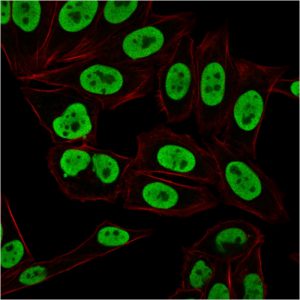
Ku (p70/p80) (Nuclear Marker) Antibody [KU729]
Price range: $259.00 through $559.00Catalog Number:2547-MSM1Gene:XRCC6Application:Flow Cytometry, ImmunofluorescenceReactivity:HumanHost:MouseIsotype:IgG1
Publication History:
iScience. 2024 Oct 16;27(11):111171. doi: 10.1016/j.isci.2024.111171


