Trial Size Available
Carrier-Free Available
| Document Name | |
|---|---|
| Datasheet | Download Here |
| Material Safety Data Sheet | Download Here |
| Applications | Tested Dilutions | Protocol | Note |
|---|---|---|---|
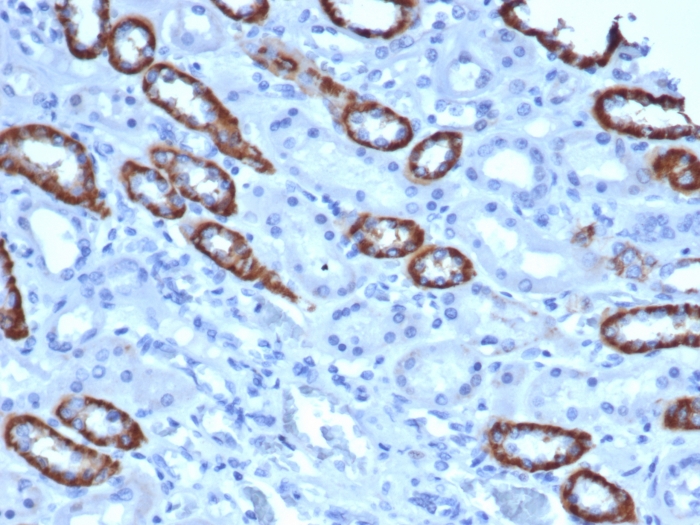
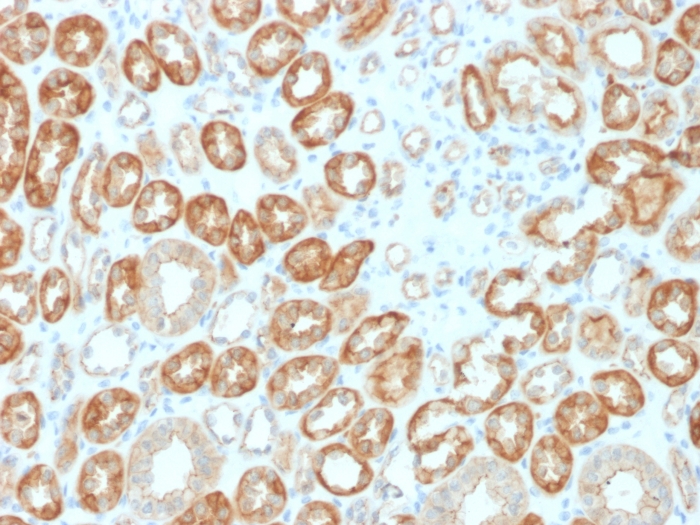
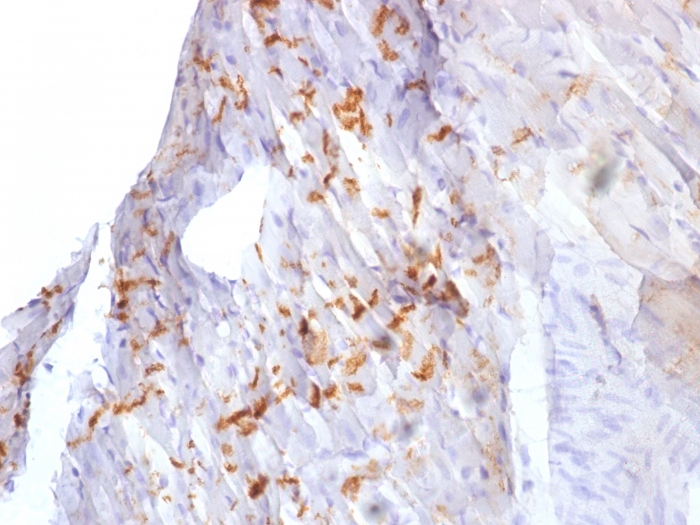
| Immunohistochemistry (IHC) | 1-2ug/ml | IHC Protocol | 30 min at RT. Staining of formalin-fixed tissues requires heating tissue sections in 10mM Tris with 1mM EDTA, pH 9.0, for 45 min at 95°C followed by cooling at RT for 20 minutes |
Maspin, a member of the serpin (serine protease inhibitor) superfamily encoded by the SERPINB5 gene, was originally identified in normal human mammary epithelial cells. Serpins are a protein family that regulate chymotrypsin-like serine proteases, playing roles in controlling activated proteases and regulating cell death. Structurally, Maspin is located in the extracellular matrix and at the plasma membrane, where it exerts its function at the cell surface by inhibiting cell motility and invasion, particularly in breast and prostate cancer cells.
Maspin is expressed in normal mammary and prostate epithelial cells but is often absent or downregulated in their corresponding tumor cells, despite no significant structural mutations in the Maspin gene being detected in these cancers. It acts as a tumor suppressor, particularly in epithelial cells, where it inhibits cancer cell invasion and metastasis. In primary breast cancer, Maspin expression is regulated by wild-type p53, linking it to a molecular mechanism that suppresses tumor invasion and metastasis. Loss of Maspin expression is associated with more aggressive tumors and worse prognosis in advanced breast and prostate cancers. Maspin expression varies significantly across cancers. While it is frequently downregulated in breast and prostate tumors, it is overexpressed in pancreatic, ovarian, thyroid, gastric, lung, bladder, skin, colon, and some breast cancers. In primary non-small cell lung cancer (NSCLC), general Maspin expression correlates with poorer overall survival, yet strong nuclear Maspin expression is linked to better overall and disease-free survival in patients with resectable NSCLC.
In summary, Maspin is a multifunctional protein with dual roles in cancer, acting as a tumor suppressor in some contexts while being overexpressed in others. Its expression patterns and subcellular localization, particularly nuclear versus cytoplasmic, have significant implications for tumor behavior and patient prognosis.
Should a NeoBiotechnologies antibody not meet the experimental expectations outlined on our website or datasheet, please contact our Technical Support. We unconditionally guarantee our product.
Our team of scientists are ready to help you with expert recommendations or technical assistance related to applications or product use.
Information
© 2026 NeoBiotechnologies. All Rights Reserved.
Monday-Friday: 8:00am – 8:00pm Pacific Time