RET Proto-oncogene Antibody [RET/8788]

In Stock
Catalog Number Formulation Size Price
5979-MSM13-P0
Purified Ab with BSA and Azide at 200ug/ml
20ug
$259.00
5979-MSM13-P1
Purified Ab with BSA and Azide at 200ug/ml
100ug
$559.00
5979-MSM13-P1ABX
Purified Ab WITHOUT BSA or Azide at 1.0mg/ml
100ug
$559.00
Flat Rate Domestic: $95 | Orders outside the US - Contact Us for Order Information | Ships next business day

Applications & Dilutions

Applications Tested Dillution Protocol Note
Immunohistochemistry (IHC)
1-2ug/ml
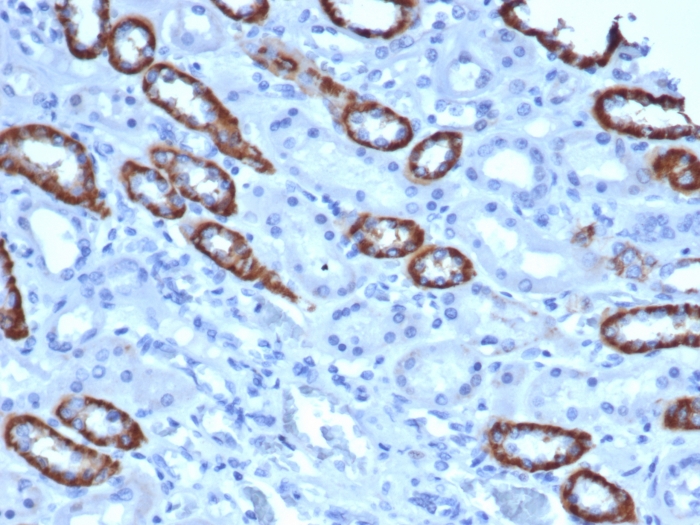
30 min at RT. Staining of formalin-fixed tissues requires heating tissue sections in 10mM Tris with 1mM EDTA, pH 9.0, for 45 min at 95°C followed by cooling at RT for 20 minutes

Summary

Receptor tyrosine-protein kinase involved in numerous cellular mechanisms including cell proliferation, neuronal navigation, cell migration, and cell differentiation in response to glia cell line-derived growth family factors (GDNF, NRTN, ARTN, PSPN and GDF15) (PubMed:20064382, PubMed:20616503, PubMed:20702524, PubMed:21357690, PubMed:21454698, PubMed:24560924, PubMed:28846097, PubMed:28846099, PubMed:28953886, PubMed:31118272). In contrast to most receptor tyrosine kinases, RET requires not only its cognate ligands but also coreceptors, for activation (PubMed:21994944, PubMed:23333276, PubMed:28846097, PubMed:28846099, PubMed:28953886). GDNF ligands (GDNF, NRTN, ARTN, PSPN and GDF15) first bind their corresponding GDNFR coreceptors (GFRA1, GFRA2, GFRA3, GFRA4 and GFRAL, respectively), triggering RET autophosphorylation and activation, leading to activation of downstream signaling pathways, including the MAPK- and AKT-signaling pathways (PubMed:21994944, PubMed:23333276, PubMed:24560924, PubMed:25242331, PubMed:28846097, PubMed:28846099, PubMed:28953886). Acts as a dependence receptor via the GDNF-GFRA1 signaling: in the presence of the ligand GDNF in somatotrophs within pituitary, promotes survival and down regulates growth hormone (GH) production, but triggers apoptosis in absence of GDNF (PubMed:20616503, PubMed:21994944). Required for the molecular mechanisms orchestration during intestine organogenesis via the ARTN-GFRA3 signaling: involved in the development of enteric nervous system and renal organogenesis during embryonic life, and promotes the formation of Peyer’s patch-like structures, a major component of the gut-associated lymphoid tissue (By similarity). Mediates, through interaction with GDF15-receptor GFRAL, GDF15-induced cell-signaling in the brainstem which triggers an aversive response, characterized by nausea, vomiting, and/or loss of appetite in response to various stresses (PubMed:28846097, PubMed:28846099, PubMed:28953886). Modulates cell adhesion via its cleavage by caspase in sympathetic neurons and mediates cell migration in an integrin (e.g. ITGB1 and ITGB3)-dependent manner (PubMed:20702524, PubMed:21357690). Also active in the absence of ligand, triggering apoptosis through a mechanism that requires receptor intracellular caspase cleavage (PubMed:21357690). Triggers the differentiation of rapidly adapting (RA) mechanoreceptors (PubMed:20064382). Involved in the development of the neural crest (By similarity). Regulates nociceptor survival and size (By similarity). Phosphorylates PTK2/FAK1 (PubMed:21454698)., Isoform 1 in complex with GFRAL induces higher activation of MAPK-signaling pathway than isoform 2 in complex with GFRAL.


Product Properties & Targets

Antibody Type
Host
Mouse
Applications
Species Reactivity
Isotype / Light Chain
IgG2c / Kappa
Cellular Localization
Cell membrane, Endosome membrane
Gene Name
RET
Immunogen
Recombinant fragment (around aa 952-1067) of human RET protein
Alternate Names
Proto-oncogene tyrosine-protein kinase receptor Ret, CDHF12|CDHR16|HSCR1|MEN2A|MEN2B|MTC1|PTC|RET-ELE1

Database Links

Entrez Gene ID
SwissProt

Additional Information

Clone
RET/8788
Chromosome Location
10q11.21
Mol. Weight of Antigen
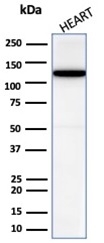
124.32kDa
Purification
Protein A

Functions

  • Receptor tyrosine-protein kinase involved in numerous cellular mechanisms including cell proliferation, neuronal navigation, cell migration, and cell differentiation in response to glia cell line-derived growth family factors (GDNF, NRTN, ARTN, PSPN and GDF15) (PubMed:20064382, PubMed:20616503, PubMed:20702524, PubMed:21357690, PubMed:21454698, PubMed:24560924, PubMed:28846097, PubMed:28846099, PubMed:28953886, PubMed:31118272). In contrast to most receptor tyrosine kinases, RET requires not only its cognate ligands but also coreceptors, for activation (PubMed:21994944, PubMed:23333276, PubMed:28846097, PubMed:28846099, PubMed:28953886). GDNF ligands (GDNF, NRTN, ARTN, PSPN and GDF15) first bind their corresponding GDNFR coreceptors (GFRA1, GFRA2, GFRA3, GFRA4 and GFRAL, respectively), triggering RET autophosphorylation and activation, leading to activation of downstream signaling pathways, including the MAPK- and AKT-signaling pathways (PubMed:21994944, PubMed:23333276, PubMed:24560924, PubMed:25242331, PubMed:28846097, PubMed:28846099, PubMed:28953886). Acts as a dependence receptor via the GDNF-GFRA1 signaling: in the presence of the ligand GDNF in somatotrophs within pituitary, promotes survival and down regulates growth hormone (GH) production, but triggers apoptosis in absence of GDNF (PubMed:20616503, PubMed:21994944). Required for the molecular mechanisms orchestration during intestine organogenesis via the ARTN-GFRA3 signaling: involved in the development of enteric nervous system and renal organogenesis during embryonic life, and promotes the formation of Peyer's patch-like structures, a major component of the gut-associated lymphoid tissue (By similarity). Mediates, through interaction with GDF15-receptor GFRAL, GDF15-induced cell-signaling in the brainstem which triggers an aversive response, characterized by nausea, vomiting, and/or loss of appetite in response to various stresses (PubMed:28846097, PubMed:28846099, PubMed:28953886). Modulates cell adhesion via its cleavage by caspase in sympathetic neurons and mediates cell migration in an integrin (e.g. ITGB1 and ITGB3)-dependent manner (PubMed:20702524, PubMed:21357690). Also active in the absence of ligand, triggering apoptosis through a mechanism that requires receptor intracellular caspase cleavage (PubMed:21357690). Triggers the differentiation of rapidly adapting (RA) mechanoreceptors (PubMed:20064382). Involved in the development of the neural crest (By similarity). Regulates nociceptor survival and size (By similarity). Phosphorylates PTK2/FAK1 (PubMed:21454698)., Isoform 1 in complex with GFRAL induces higher activation of MAPK-signaling pathway than isoform 2 in complex with GFRAL.

Storage & Stability

Antibody with azide - store at 2 to 8 °C. Antibody without azide - store at -20 to -80 °C. Antibody is stable for 24 months. Non-hazardous. No MSDS required.

Limitations

This antibody is available for research use only and is not approved for use in diagnosis.

Supplied as

200ug/ml of Ab purified from Bioreactor Concentrate by Protein A. Prepared in 10mM PBS with 0.05% BSA & 0.05% azide. Also available WITHOUT BSA & azide at 1.0mg/ml.

Warranty

There are no warranties, expressed or implied, which extend beyond this description. Company is not liable for any personal injury or economic loss resulting from this product.
PARTNERSHIP OPPORTUNITIES

NeoBiotechnologies holds Exclusive rights to 10,000 recombinant and hybridoma antibody products, available for Licensing or Collaboration.

LETS TALK