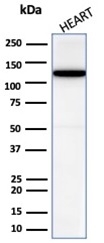
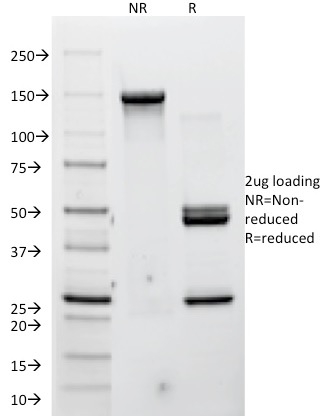
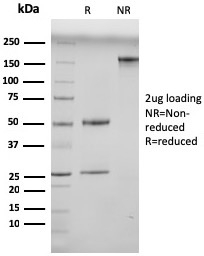
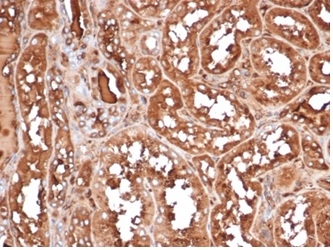
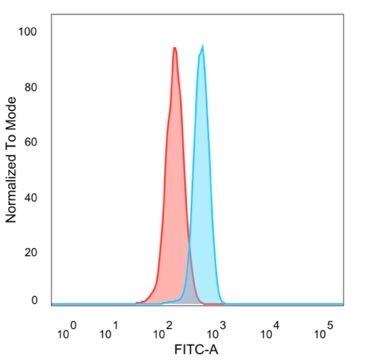
Expressed on the surface of activated T-cells, B-cells, natural killer cells, neutrophils, eosinophils, epidermal Langerhans cells and platelets
Immunogen
Recombinant human CD69 protein
Purification
Protein A
Storage & Stability
Antibody with azide - store at 2 to 8 °C. Antibody without azide - store at -20 to -80 °C. Antibody is stable for 24 months. Non-hazardous. No MSDS required.
Supplied as
200ug/ml of Ab produced in a mammalian-based expression system. Prepared in 10mM PBS with 0.05% BSA & 0.05% azide. Also available WITHOUT BSA & azide at 1.0mg/ml.
Limitations
This antibody is available for research use only and is not approved for use in diagnosis.
Transmembrane protein expressed mainly on T-cells resident in mucosa that plays an essential role in immune cell homeostasis. Rapidly expressed on the surface of platelets, T-lymphocytes and NK cells upon activation by various stimuli, such as antigen recognition or cytokine signaling, stimulates different signaling pathways in different cell types (PubMed:24752896, PubMed:26296369, PubMed:35930205). Negatively regulates Th17 cell differentiation through its carbohydrate dependent interaction with galectin-1/LGALS1 present on immature dendritic cells (PubMed:24752896). Association of CD69 cytoplasmic tail with the JAK3/STAT5 signaling pathway regulates the transcription of RORgamma/RORC and, consequently, differentiation toward the Th17 lineage (By similarity). Also acts via the S100A8/S100A9 complex present on peripheral blood mononuclear cells to promote the conversion of naive CD4 T-cells into regulatory T-cells (PubMed:26296369). Acts as an oxidized low-density lipoprotein (oxLDL) receptor in CD4 T-lymphocytes and negatively regulates the inflammatory response by inducing the expression of PDCD1 through the activation of NFAT (PubMed:35930205). Participates in adipose tissue-derived mesenchymal stem cells (ASCs)-mediated protection against P.aeruginosa infection. Mechanistically, specifically recognizes P.aeruginosa to promote ERK1 activation, followed by granulocyte-macrophage colony-stimulating factor (GM-CSF) and other inflammatory cytokines secretion (PubMed:34841721). In eosinophils, induces IL-10 production through the ERK1/2 pathway (By similarity). Negatively regulates the chemotactic responses of effector lymphocytes and dendritic cells (DCs) to sphingosine 1 phosphate/S1P by acting as a S1PR1 receptor agonist and facilitating the internalization and degradation of the receptor (PubMed:37039481).
There are no warranties, expressed or implied, which extend beyond this description. Company is not liable for any personal injury or economic loss resulting from this product.
Early activation antigen CD69, AIM|BL-AC/P26|CLEC2C|EA1|GP32/28|MLR-3
Summary
Transmembrane protein expressed mainly on T-cells resident in mucosa that plays an essential role in immune cell homeostasis. Rapidly expressed on the surface of platelets, T-lymphocytes and NK cells upon activation by various stimuli, such as antigen recognition or cytokine signaling, stimulates different signaling pathways in different cell types (PubMed:24752896, PubMed:26296369, PubMed:35930205). Negatively regulates Th17 cell differentiation through its carbohydrate dependent interaction with galectin-1/LGALS1 present on immature dendritic cells (PubMed:24752896). Association of CD69 cytoplasmic tail with the JAK3/STAT5 signaling pathway regulates the transcription of RORgamma/RORC and, consequently, differentiation toward the Th17 lineage (By similarity). Also acts via the S100A8/S100A9 complex present on peripheral blood mononuclear cells to promote the conversion of naive CD4 T-cells into regulatory T-cells (PubMed:26296369). Acts as an oxidized low-density lipoprotein (oxLDL) receptor in CD4 T-lymphocytes and negatively regulates the inflammatory response by inducing the expression of PDCD1 through the activation of NFAT (PubMed:35930205). Participates in adipose tissue-derived mesenchymal stem cells (ASCs)-mediated protection against P.aeruginosa infection. Mechanistically, specifically recognizes P.aeruginosa to promote ERK1 activation, followed by granulocyte-macrophage colony-stimulating factor (GM-CSF) and other inflammatory cytokines secretion (PubMed:34841721). In eosinophils, induces IL-10 production through the ERK1/2 pathway (By similarity). Negatively regulates the chemotactic responses of effector lymphocytes and dendritic cells (DCs) to sphingosine 1 phosphate/S1P by acting as a S1PR1 receptor agonist and facilitating the internalization and degradation of the receptor (PubMed:37039481).
Worry-Free Guarantee
Should a NeoBiotechnologies antibody not meet the experimental expectations outlined on our website or datasheet, please contact our Technical Support. We unconditionally guarantee our product.







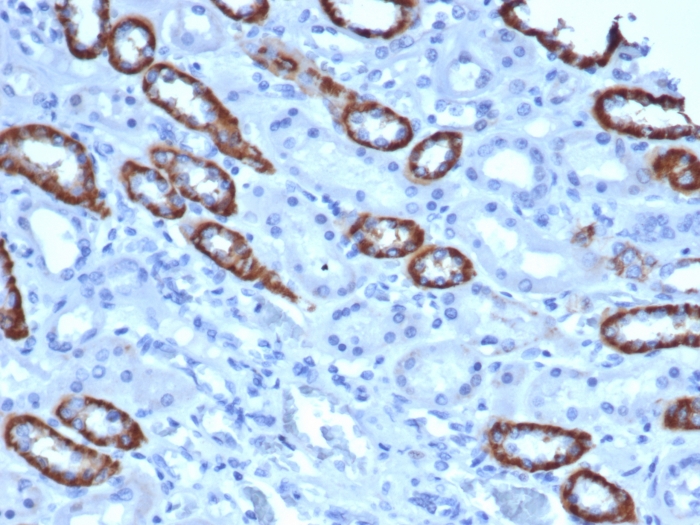
 1
1