Trial Size Available
Carrier-Free Available
| Document Name | |
|---|---|
| Datasheet | Download Here |
| Material Safety Data Sheet | Download Here |
| Applications | Tested Dilutions | Protocol |
|---|---|---|
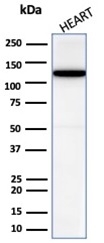
| Western Blot (WB) | 2-4ug/ml | Western Blot Protocol |
Deubiquitinating enzyme that plays a key role in chromatin by mediating deubiquitination of histone H2A and HCFC1 (PubMed:12485996, PubMed:18757409, PubMed:20436459, PubMed:25451922, PubMed:35051358). Catalytic component of the polycomb repressive deubiquitinase (PR-DUB) complex, a complex that specifically mediates deubiquitination of histone H2A monoubiquitinated at ‘Lys-120’ (H2AK119ub1) (PubMed:20436459, PubMed:25451922, PubMed:30664650, PubMed:35051358). Does not deubiquitinate monoubiquitinated histone H2B (PubMed:20436459, PubMed:30664650). The PR-DUB complex is an epigenetic regulator of gene expression and acts as a transcriptional coactivator, affecting genes involved in development, cell communication, signaling, cell proliferation and cell viability (PubMed:20805357, PubMed:30664650, PubMed:36180891). Antagonizes PRC1 mediated H2AK119ub1 monoubiquitination (PubMed:30664650). As part of the PR-DUB complex, associates with chromatin enriched in histone marks H3K4me1, H3K4me3, and H3K27Ac, but not in H3K27me3 (PubMed:36180891). Recruited to specific gene-regulatory regions by YY1 (PubMed:20805357). Acts as a regulator of cell growth by mediating deubiquitination of HCFC1 N-terminal and C-terminal chains, with some specificity toward ‘Lys-48’-linked polyubiquitin chains compared to ‘Lys-63’-linked polyubiquitin chains (PubMed:19188440, PubMed:19815555). Deubiquitination of HCFC1 does not lead to increase stability of HCFC1 (PubMed:19188440, PubMed:19815555). Interferes with the BRCA1 and BARD1 heterodimer activity by inhibiting their ability to mediate ubiquitination and autoubiquitination (PubMed:19117993). It however does not mediate deubiquitination of BRCA1 and BARD1 (PubMed:19117993). Able to mediate autodeubiquitination via intramolecular interactions to counteract monoubiquitination at the nuclear localization signal (NLS), thereby protecting it from cytoplasmic sequestration (PubMed:24703950). Negatively regulates epithelial-mesenchymal transition (EMT) of trophoblast stem cells during placental development by regulating genes involved in epithelial cell integrity, cell adhesion and cytoskeletal organization (PubMed:34170818).
Should a NeoBiotechnologies antibody not meet the experimental expectations outlined on our website or datasheet, please contact our Technical Support. We unconditionally guarantee our product.
Our team of scientists are ready to help you with expert recommendations or technical assistance related to applications or product use.
Information
© 2026 NeoBiotechnologies. All Rights Reserved.
Monday-Friday: 8:00am – 8:00pm Pacific Time