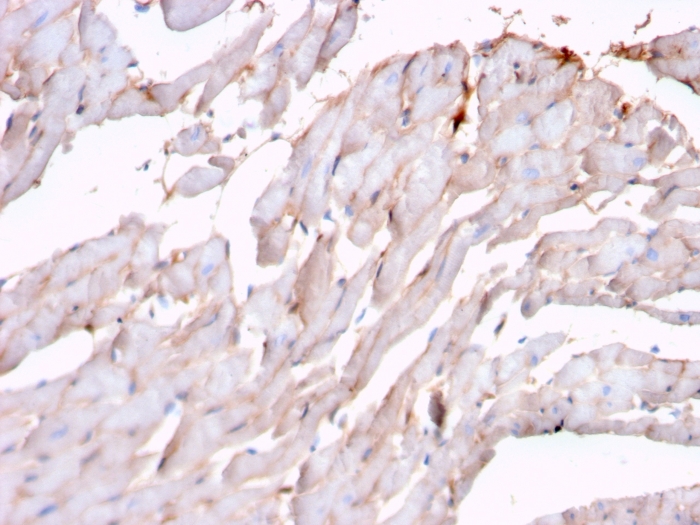
Recombinant Macrophage colony-stimulating factor 1 receptor Antibody [CSF1R/7460R]

Additional information

Catalog Number: 1436-RBM1
Gene:

Host:

Reactivity:

In Stock

Trial Size Available

Carrier-Free Available

In Stock
Catalog Number Formulation Size Price
1436-RBM1-P0
Purified Ab with BSA and Azide at 200ug/ml
20ug
$259.00
1436-RBM1-P1
Purified Ab with BSA and Azide at 200ug/ml
100ug
$559.00
1436-RBM1-P1ABX
Purified Ab WITHOUT BSA or Azide at 1.0mg/ml
100ug
$559.00
Flat Rate Domestic: $95 | Orders outside the US - Contact Us for Order Information | Ships next business day
  • IHC

Documents

Document Name
Datasheet Download Here
Material Safety Data Sheet Download Here

Applications & Dilutions

Applications Tested Dilutions Protocol Note
Immunohistochemistry (IHC) 1-2ug/ml IHC Protocol 30 min at RT. Staining of formalin-fixed tissues requires heating tissue sections in 10mM Tris with 1mM EDTA, pH 9.0, for 45 min at 95°C followed by cooling at RT for 20 minutes

Product Properties

Host
Rabbit
Applications
Species Reactivity
Clone
CSF1R/7460R
Isotype
IgG
Light Chain
Kappa
Cellular Localization
Cell membrane
Gene Name
Positive Control
Expressed in bone marrow and in differentiated blood mononuclear cells
Immunogen
Recombinant full-length human CSF1R protein
Purification
Protein A
Storage & Stability
Antibody with azide - store at 2 to 8 °C. Antibody without azide - store at -20 to -80 °C. Antibody is stable for 24 months. Non-hazardous. No MSDS required.
Supplied as
200ug/ml of Ab produced in a mammalian-based expression system. Prepared in 10mM PBS with 0.05% BSA & 0.05% azide. Also available WITHOUT BSA & azide at 1.0mg/ml.
Limitations
This antibody is available for research use only and is not approved for use in diagnosis.

Related Antibodies

Other Information

Functions
Warranty
There are no warranties, expressed or implied, which extend beyond this description. Company is not liable for any personal injury or economic loss resulting from this product.
Entrez Gene ID
SwissProt
Chromosome Location
5q32
Mol. Weight of Antigen
107.98kDa
Alternate Names
Macrophage colony-stimulating factor 1 receptor, BANDDOS|C-FMS|CD115|CSF-1R|CSFR|FIM2|FMS|GPSC|HDLS|HDLS1|M-CSF-R

Summary

Tyrosine-protein kinase that acts as a cell-surface receptor for CSF1 and IL34 and plays an essential role in the regulation of survival, proliferation and differentiation of hematopoietic precursor cells, especially mononuclear phagocytes, such as macrophages and monocytes. Promotes the release of pro-inflammatory chemokines in response to IL34 and CSF1, and thereby plays an important role in innate immunity and in inflammatory processes. Plays an important role in the regulation of osteoclast proliferation and differentiation, the regulation of bone resorption, and is required for normal bone and tooth development. Required for normal male and female fertility, and for normal development of milk ducts and acinar structures in the mammary gland during pregnancy. Promotes reorganization of the actin cytoskeleton, regulates formation of membrane ruffles, cell adhesion and cell migration, and promotes cancer cell invasion. Activates several signaling pathways in response to ligand binding, including the ERK1/2 and the JNK pathway (PubMed:20504948, PubMed:30982609). Phosphorylates PIK3R1, PLCG2, GRB2, SLA2 and CBL. Activation of PLCG2 leads to the production of the cellular signaling molecules diacylglycerol and inositol 1,4,5-trisphosphate, that then lead to the activation of protein kinase C family members, especially PRKCD. Phosphorylation of PIK3R1, the regulatory subunit of phosphatidylinositol 3-kinase, leads to activation of the AKT1 signaling pathway. Activated CSF1R also mediates activation of the MAP kinases MAPK1/ERK2 and/or MAPK3/ERK1, and of the SRC family kinases SRC, FYN and YES1. Activated CSF1R transmits signals both via proteins that directly interact with phosphorylated tyrosine residues in its intracellular domain, or via adapter proteins, such as GRB2. Promotes activation of STAT family members STAT3, STAT5A and/or STAT5B. Promotes tyrosine phosphorylation of SHC1 and INPP5D/SHIP-1. Receptor signaling is down-regulated by protein phosphatases, such as INPP5D/SHIP-1, that dephosphorylate the receptor and its downstream effectors, and by rapid internalization of the activated receptor. In the central nervous system, may play a role in the development of microglia macrophages (PubMed:30982608).

Worry-Free Guarantee

Should a NeoBiotechnologies antibody not meet the experimental expectations outlined on our website or datasheet, please contact our Technical Support. We unconditionally guarantee our product.

Need Technical Help?

Our team of scientists are ready to help you with expert recommendations or technical assistance related to applications or product use.