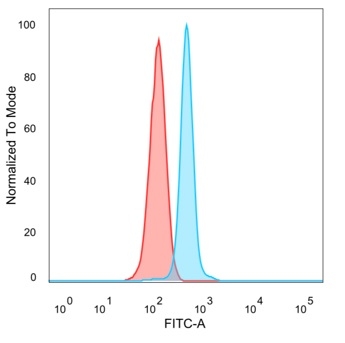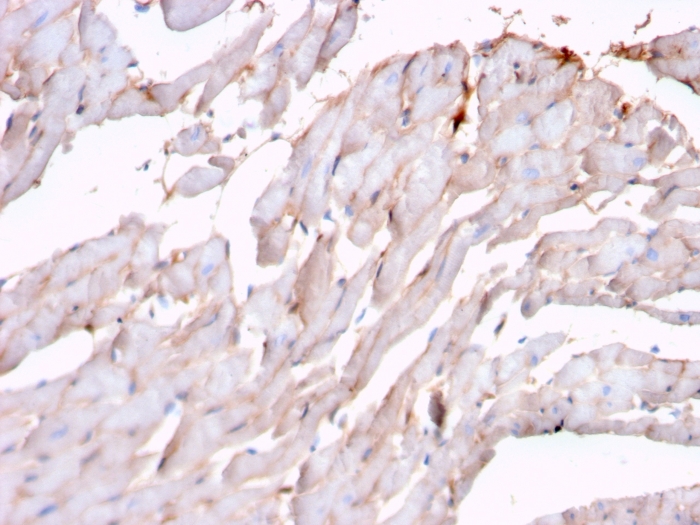
Recombinant Cathepsin G (Neutrophil Marker) Antibody [CTSG/9807R]

In Stock
Catalog Number Formulation Size Price
1511-RBM1-P0
Purified Ab with BSA and Azide at 200ug/ml
20ug
$259.00
1511-RBM1-P1
Purified Ab with BSA and Azide at 200ug/ml
100ug
$559.00
1511-RBM1-P1ABX
Purified Ab WITHOUT BSA or Azide at 1.0mg/ml
100ug
$559.00
Flat Rate Domestic: $95 | Orders outside the US - Contact Us for Order Information | Ships next business day

Applications & Dilutions

Applications Tested Dillution Protocol Note
Immunohistochemistry (IHC)
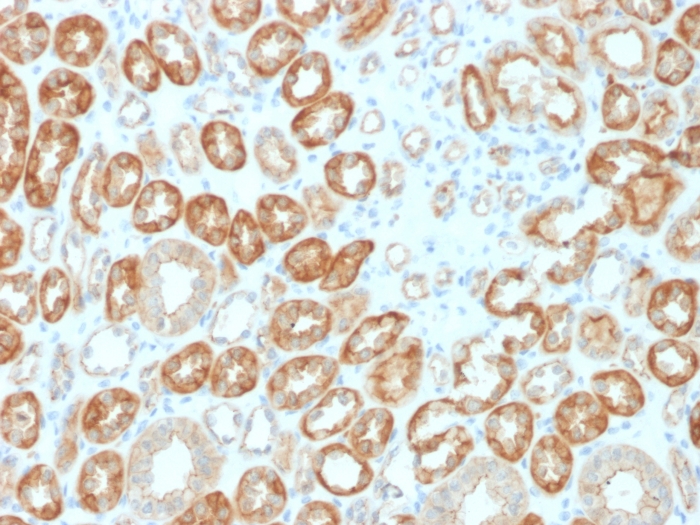
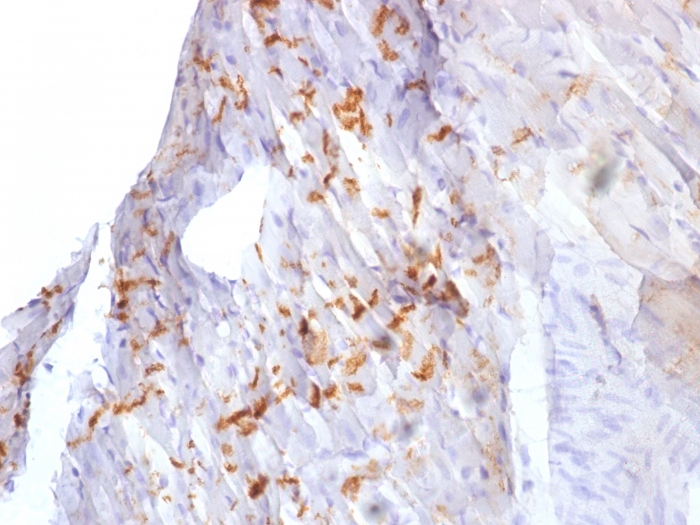
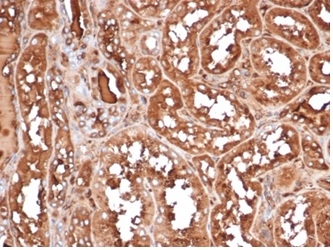
1-2ug/ml
30 min at RT. Staining of formalin-fixed tissues requires heating tissue sections in 10mM Tris with 1mM EDTA, pH 9.0, for 45 min at 95°C followed by cooling at RT for 20 minutes
Western Blot (WB)
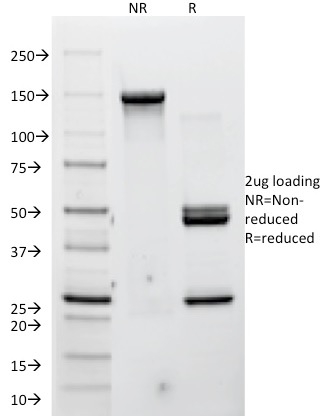
2-4ug/ml

Summary

Serine protease with trypsin- and chymotrypsin-like specificity (PubMed:29652924, PubMed:8194606). Also displays antibacterial activity against Gram-negative and Gram-positive bacteria independent of its protease activity (PubMed:2116408, PubMed:2117044). Prefers Phe and Tyr residues in the P1 position of substrates but also cleaves efficiently after Trp and Leu (PubMed:29652924). Shows a preference for negatively charged amino acids in the P2′ position and for aliphatic amino acids both upstream and downstream of the cleavage site (PubMed:29652924). Required for recruitment and activation of platelets which is mediated by the F2RL3/PAR4 platelet receptor (PubMed:10702240, PubMed:3390156). Binds reversibly to and stimulates B cells and CD4(+) and CD8(+) T cells (PubMed:7842483, PubMed:9000539). Also binds reversibly to natural killer (NK) cells and enhances NK cell cytotoxicity through its protease activity (PubMed:9000539, PubMed:9536127). Cleaves complement C3 (PubMed:1861080). Cleaves vimentin (By similarity). Cleaves thrombin receptor F2R/PAR1 and acts as either an agonist or an inhibitor, depending on the F2R cleavage site (PubMed:10702240, PubMed:7744748). Cleavage of F2R at ’41-Arg-|-Ser-42′ results in receptor activation while cleavage at ’55-Phe-|-Trp-56′ results in inhibition of receptor activation (PubMed:7744748). Cleaves the synovial mucin-type protein PRG4/lubricin (PubMed:32144329). Cleaves and activates IL36G which promotes expression of chemokines CXCL1 and CXLC8 in keratinocytes (PubMed:30804664). Cleaves IL33 into mature forms which have greater activity than the unprocessed form (PubMed:22307629). Cleaves coagulation factor F8 to produce a partially activated form (PubMed:18217133). Also cleaves and activates coagulation factor F10 (PubMed:8920993). Cleaves leukocyte cell surface protein SPN/CD43 to release its extracellular domain and trigger its intramembrane proteolysis by gamma-secretase, releasing the CD43 cytoplasmic tail chain (CD43-ct) which translocates to the nucleus (PubMed:18586676). Cleaves CCL5/RANTES to produce RANTES(4-68) lacking the N-terminal three amino acids which exhibits reduced chemotactic and antiviral activities (PubMed:16963625). During apoptosis, cleaves SMARCA2/BRM to produce a 160 kDa cleavage product which localizes to the cytosol (PubMed:11259672). Cleaves myelin basic protein MBP in B cell lysosomes at ‘224-Phe-|-Lys-225’ and ‘248-Phe-|-Ser-249’, degrading the major immunogenic MBP epitope and preventing the activation of MBP-specific autoreactive T cells (PubMed:15100291). Cleaves annexin ANXA1 and antimicrobial peptide CAMP to produce peptides which act on neutrophil N-formyl peptide receptors to enhance the release of CXCL2 (PubMed:22879591). Acts as a ligand for the N-formyl peptide receptor FPR1, enhancing phagocyte chemotaxis (PubMed:15210802). Has antibacterial activity against the Gram-negative bacteria N.gonorrhoeae and P.aeruginosa (PubMed:1937776, PubMed:2116408). Likely to act against N.gonorrhoeae by interacting with N.gonorrhoeae penA/PBP2 (PubMed:2126324). Exhibits potent antimicrobial activity against the Gram-positive bacterium L.monocytogenes (PubMed:2117044). Has antibacterial activity against the Gram-positive bacterium S.aureus and degrades S.aureus biofilms, allowing polymorphonuclear leukocytes to penetrate the biofilm and phagocytose bacteria (PubMed:2117044, PubMed:32995850). Has antibacterial activity against M.tuberculosis (PubMed:15385470). Mediates CASP4 activation induced by the Td92 surface protein of the periodontal pathogen T.denticola, causing production and secretion of IL1A and leading to pyroptosis of gingival fibroblasts (PubMed:29077095). Induces platelet aggregation which is strongly potentiated in the presence of ELANE (PubMed:25211214, PubMed:9111081).

Product Properties & Targets

Host
Rabbit
Species Reactivity
Isotype / Light Chain
IgG / Kappa
Cellular Localization
Cell membrane, Cytoplasm, Cytoplasmic granule, Cytosol, Lysosome, Nucleus, Secreted
Gene Name
Positive Control
Expressed in neutrophils (at protein level) (PubMed:3799965)
Immunogen
Recombinant fragment corresponding to the n-terminal region of the human Cathepsin G protein
Alternate Names
Cathepsin G, CATG|CG

Database Links

Entrez Gene ID
SwissProt

Additional Information

Clone
CTSG/9807R
Chromosome Location
14q12
Mol. Weight of Antigen
28.84kDa
Expression System
CHO Cells
Purification
Protein A

Functions

  • Serine protease with trypsin- and chymotrypsin-like specificity (PubMed:29652924, PubMed:8194606). Also displays antibacterial activity against Gram-negative and Gram-positive bacteria independent of its protease activity (PubMed:2116408, PubMed:2117044). Prefers Phe and Tyr residues in the P1 position of substrates but also cleaves efficiently after Trp and Leu (PubMed:29652924). Shows a preference for negatively charged amino acids in the P2' position and for aliphatic amino acids both upstream and downstream of the cleavage site (PubMed:29652924). Required for recruitment and activation of platelets which is mediated by the F2RL3/PAR4 platelet receptor (PubMed:10702240, PubMed:3390156). Binds reversibly to and stimulates B cells and CD4(+) and CD8(+) T cells (PubMed:7842483, PubMed:9000539). Also binds reversibly to natural killer (NK) cells and enhances NK cell cytotoxicity through its protease activity (PubMed:9000539, PubMed:9536127). Cleaves complement C3 (PubMed:1861080). Cleaves vimentin (By similarity). Cleaves thrombin receptor F2R/PAR1 and acts as either an agonist or an inhibitor, depending on the F2R cleavage site (PubMed:10702240, PubMed:7744748). Cleavage of F2R at '41-Arg-
  • -Ser-42' results in receptor activation while cleavage at '55-Phe-
  • -Trp-56' results in inhibition of receptor activation (PubMed:7744748). Cleaves the synovial mucin-type protein PRG4/lubricin (PubMed:32144329). Cleaves and activates IL36G which promotes expression of chemokines CXCL1 and CXLC8 in keratinocytes (PubMed:30804664). Cleaves IL33 into mature forms which have greater activity than the unprocessed form (PubMed:22307629). Cleaves coagulation factor F8 to produce a partially activated form (PubMed:18217133). Also cleaves and activates coagulation factor F10 (PubMed:8920993). Cleaves leukocyte cell surface protein SPN/CD43 to release its extracellular domain and trigger its intramembrane proteolysis by gamma-secretase, releasing the CD43 cytoplasmic tail chain (CD43-ct) which translocates to the nucleus (PubMed:18586676). Cleaves CCL5/RANTES to produce RANTES(4-68) lacking the N-terminal three amino acids which exhibits reduced chemotactic and antiviral activities (PubMed:16963625). During apoptosis, cleaves SMARCA2/BRM to produce a 160 kDa cleavage product which localizes to the cytosol (PubMed:11259672). Cleaves myelin basic protein MBP in B cell lysosomes at '224-Phe-
  • -Lys-225' and '248-Phe-
  • -Ser-249', degrading the major immunogenic MBP epitope and preventing the activation of MBP-specific autoreactive T cells (PubMed:15100291). Cleaves annexin ANXA1 and antimicrobial peptide CAMP to produce peptides which act on neutrophil N-formyl peptide receptors to enhance the release of CXCL2 (PubMed:22879591). Acts as a ligand for the N-formyl peptide receptor FPR1, enhancing phagocyte chemotaxis (PubMed:15210802). Has antibacterial activity against the Gram-negative bacteria N.gonorrhoeae and P.aeruginosa (PubMed:1937776, PubMed:2116408). Likely to act against N.gonorrhoeae by interacting with N.gonorrhoeae penA/PBP2 (PubMed:2126324). Exhibits potent antimicrobial activity against the Gram-positive bacterium L.monocytogenes (PubMed:2117044). Has antibacterial activity against the Gram-positive bacterium S.aureus and degrades S.aureus biofilms, allowing polymorphonuclear leukocytes to penetrate the biofilm and phagocytose bacteria (PubMed:2117044, PubMed:32995850). Has antibacterial activity against M.tuberculosis (PubMed:15385470). Mediates CASP4 activation induced by the Td92 surface protein of the periodontal pathogen T.denticola, causing production and secretion of IL1A and leading to pyroptosis of gingival fibroblasts (PubMed:29077095). Induces platelet aggregation which is strongly potentiated in the presence of ELANE (PubMed:25211214, PubMed:9111081).

Storage & Stability

Antibody with azide - store at 2 to 8 °C. Antibody without azide - store at -20 to -80 °C. Antibody is stable for 24 months. Non-hazardous. No MSDS required.

Limitations

This antibody is available for research use only and is not approved for use in diagnosis.

Supplied as

200ug/ml of Ab produced in a mammalian-based expression system. Prepared in 10mM PBS with 0.05% BSA & 0.05% azide. Also available WITHOUT BSA & azide at 1.0mg/ml.

Warranty

There are no warranties, expressed or implied, which extend beyond this description. Company is not liable for any personal injury or economic loss resulting from this product.
PARTNERSHIP OPPORTUNITIES

NeoBiotechnologies holds Exclusive rights to 10,000 recombinant and hybridoma antibody products, available for Licensing or Collaboration.

LETS TALK