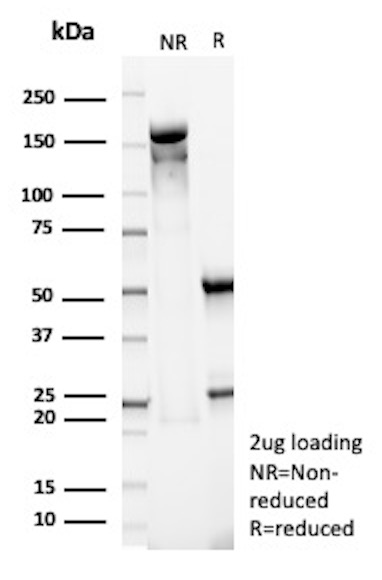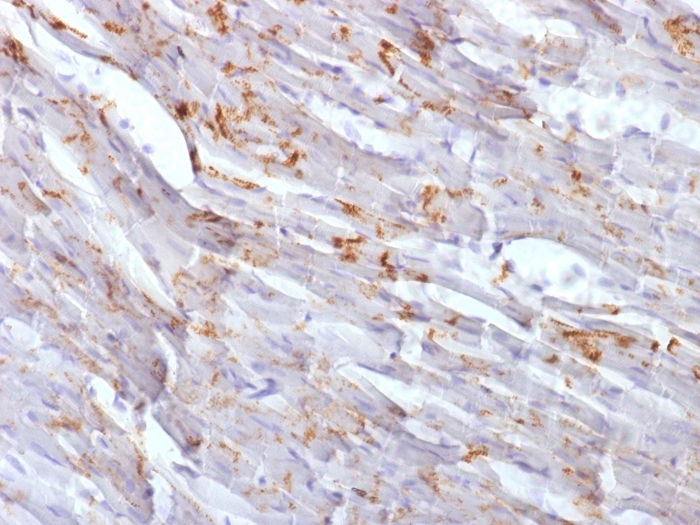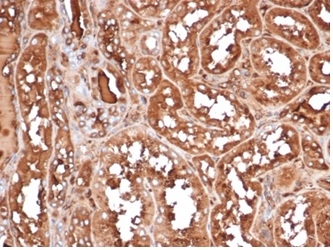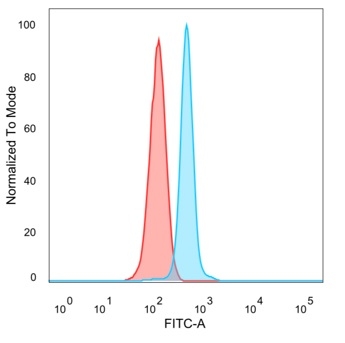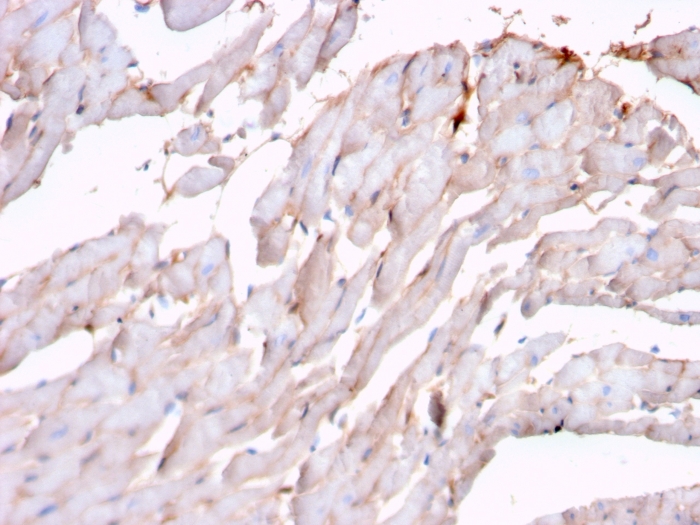
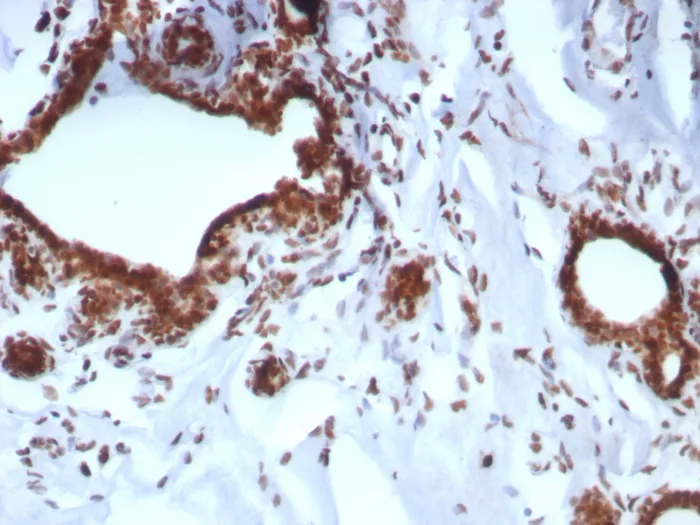
Recombinant BAP1 (BRCA1 Associated Protein 1) Antibody [BAP1/8959R]

In Stock
Catalog Number Formulation Size Price
8314-RBM16-P0
Purified Ab with BSA and Azide at 200ug/ml
20ug
$259.00
8314-RBM16-P1
Purified Ab with BSA and Azide at 200ug/ml
100ug
$559.00
8314-RBM16-P1ABX
Purified Ab WITHOUT BSA or Azide at 1.0mg/ml
100ug
$559.00
Flat Rate Domestic: $95 | Orders outside the US - Contact Us for Order Information | Ships next business day

Applications & Dilutions

Applications Tested Dillution Protocol Note
Immunohistochemistry (IHC)
1-2ug/ml
30 min at RT. Staining of formalin-fixed tissues requires heating tissue sections in 10mM Tris with 1mM EDTA, pH 9.0, for 45 min at 95°C followed by cooling at RT for 20 minutes
Western Blot (WB)
2-4ug/ml

Summary

The BAP1 gene belongs to the ubiquitin C-terminal hydrolase subfamily of de-ubiquitination enzymes that are involved in the removal of ubiquitin from proteins. The encoded enzyme binds to the breast cancer type 1 susceptibility protein (BRCA1) via the RING finger domain of the latter and acts as a tumor suppressor. In addition, the enzyme may be involved in regulation of transcription, regulation of cell cycle and growth, response to DNA damage and chromatin dynamics. Germ line mutations in this gene may be associated with tumor predisposition syndrome (TPDS), which involves increased risk of cancers including malignant mesothelioma, Uveal melanoma and cutaneous melanoma.

Product Properties & Targets

Host
Rabbit
Species Reactivity
Isotype / Light Chain
IgG / Kappa
Cellular Localization
Chromosome, Cytoplasm, Nucleus
Gene Name
Positive Control
Human breast or malignant mesothelioma.
Immunogen
Recombinant fragment (around aa710-729) of the human BAP1 protein (exact sequence is proprietary)
Alternate Names
Ubiquitin carboxyl-terminal hydrolase BAP1, HUCEP-13|KURIS|TPDS1|UBM2|UCHL2|UVM2|hucep-6

Database Links

Entrez Gene ID
SwissProt

Additional Information

Clone
BAP1/8959R
Chromosome Location
3p21.1
Mol. Weight of Antigen
80.36kDa
Expression System
CHO Cells
Purification
Protein A

Functions

  • Deubiquitinating enzyme that plays a key role in chromatin by mediating deubiquitination of histone H2A and HCFC1 (PubMed:12485996, PubMed:18757409, PubMed:20436459, PubMed:25451922, PubMed:35051358). Catalytic component of the polycomb repressive deubiquitinase (PR-DUB) complex, a complex that specifically mediates deubiquitination of histone H2A monoubiquitinated at 'Lys-120' (H2AK119ub1) (PubMed:20436459, PubMed:25451922, PubMed:30664650, PubMed:35051358). Does not deubiquitinate monoubiquitinated histone H2B (PubMed:20436459, PubMed:30664650). The PR-DUB complex is an epigenetic regulator of gene expression and acts as a transcriptional coactivator, affecting genes involved in development, cell communication, signaling, cell proliferation and cell viability (PubMed:20805357, PubMed:30664650, PubMed:36180891). Antagonizes PRC1 mediated H2AK119ub1 monoubiquitination (PubMed:30664650). As part of the PR-DUB complex, associates with chromatin enriched in histone marks H3K4me1, H3K4me3, and H3K27Ac, but not in H3K27me3 (PubMed:36180891). Recruited to specific gene-regulatory regions by YY1 (PubMed:20805357). Acts as a regulator of cell growth by mediating deubiquitination of HCFC1 N-terminal and C-terminal chains, with some specificity toward 'Lys-48'-linked polyubiquitin chains compared to 'Lys-63'-linked polyubiquitin chains (PubMed:19188440, PubMed:19815555). Deubiquitination of HCFC1 does not lead to increase stability of HCFC1 (PubMed:19188440, PubMed:19815555). Interferes with the BRCA1 and BARD1 heterodimer activity by inhibiting their ability to mediate ubiquitination and autoubiquitination (PubMed:19117993). It however does not mediate deubiquitination of BRCA1 and BARD1 (PubMed:19117993). Able to mediate autodeubiquitination via intramolecular interactions to counteract monoubiquitination at the nuclear localization signal (NLS), thereby protecting it from cytoplasmic sequestration (PubMed:24703950). Negatively regulates epithelial-mesenchymal transition (EMT) of trophoblast stem cells during placental development by regulating genes involved in epithelial cell integrity, cell adhesion and cytoskeletal organization (PubMed:34170818).

Storage & Stability

Antibody with azide - store at 2 to 8 °C. Antibody without azide - store at -20 to -80 °C. Antibody is stable for 24 months. Non-hazardous. No MSDS required.

Limitations

This antibody is available for research use only and is not approved for use in diagnosis.

Supplied as

200ug/ml of Ab produced in a mammalian-based expression system. Prepared in 10mM PBS with 0.05% BSA & 0.05% azide. Also available WITHOUT BSA & azide at 1.0mg/ml.

Warranty

There are no warranties, expressed or implied, which extend beyond this description. Company is not liable for any personal injury or economic loss resulting from this product.
PARTNERSHIP OPPORTUNITIES

NeoBiotechnologies holds Exclusive rights to 10,000 recombinant and hybridoma antibody products, available for Licensing or Collaboration.

LETS TALK