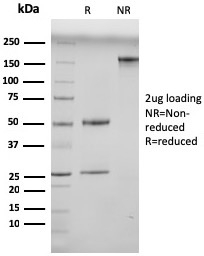
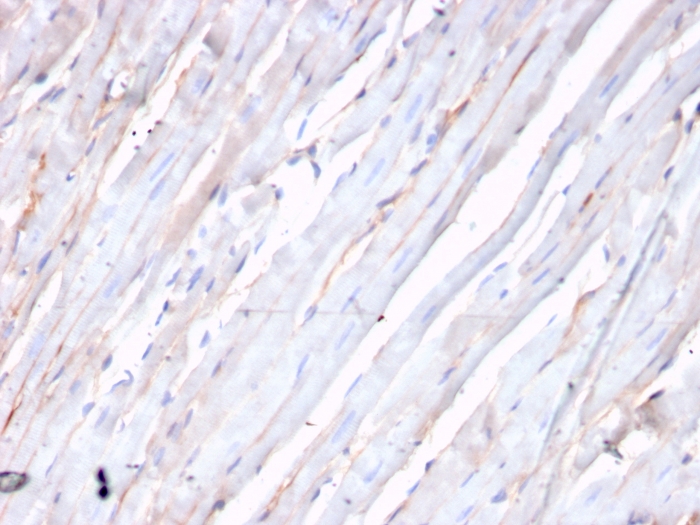
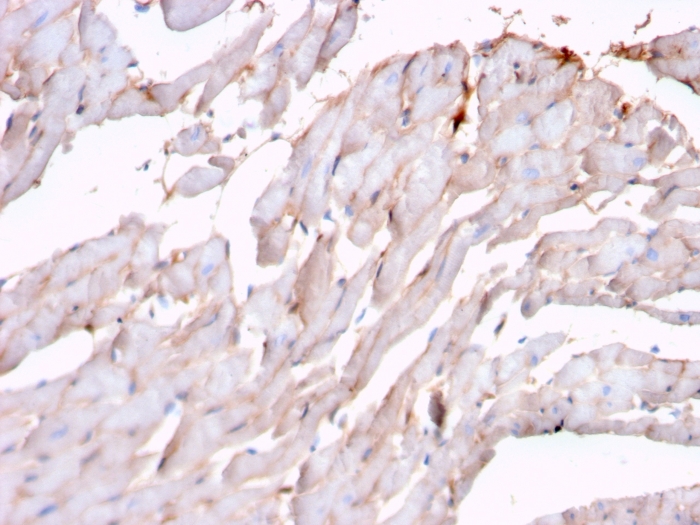
30 min at RT. Staining of formalin-fixed tissues requires heating tissue sections in 10mM Tris with 1mM EDTA, pH 9.0, for 45 min at 95°C followed by cooling at RT for 20 minutes
Antibody with azide - store at 2 to 8 °C. Antibody without azide - store at -20 to -80 °C. Antibody is stable for 24 months. Non-hazardous. No MSDS required.
Supplied as
200ug/ml of Ab purified from Bioreactor Concentrate by Protein A. Prepared in 10mM PBS with 0.05% BSA & 0.05% azide. Also available WITHOUT BSA & azide at 1.0mg/ml.
Limitations
This antibody is available for research use only and is not approved for use in diagnosis.
K(+) channel that conducts voltage-dependent outward rectifying currents upon membrane depolarization. Voltage sensing is coupled to K(+) electrochemical gradient in an 'ion flux gating' mode where outward but not inward ion flow opens the gate (PubMed:11042359, PubMed:11431495, PubMed:26919430, PubMed:38630723). Changes ion selectivity and becomes permeable to Na(+) ions in response to extracellular acidification. Protonation of the pH sensor His-98 stabilizes C-type inactivation conformation likely converting the channel from outward K(+)-conducting, to inward Na(+)-conducting to nonconductive state (PubMed:22948150, PubMed:38630723). Homo- and heterodimerizes to form functional channels with distinct regulatory and gating properties (By similarity) (PubMed:23169818, PubMed:38630723). Allows K(+) currents with fast-gating kinetics important for the repolarization and hyperpolarization phases of action potentials (By similarity). In granule neurons, hyperpolarizes the resting membrane potential to limit intrinsic neuronal excitability, but once the action potential threshold is reached, supports high-frequency action potential firing and increased neuronal excitability. Homomeric and/or heteromeric KCNK3:KCNK9 channels operate in cerebellar granule cells, whereas heteromeric KCNK1:KCNK9 enables currents in hippocampal dentate gyrus granule neurons (By similarity). Dispensable for central chemosensory respiration i.e. breathing controlled by brainstem CO2/pH, it rather conducts pH-sensitive currents and controls the firing rate of serotonergic raphe neurons involved in potentiation of the respiratory chemoreflex (By similarity). In retinal ganglion cells, mediates outward currents that regulate action potentials in response to acidification of the synaptic cleft. Involved in transmission of image-forming and nonimage-forming visual information in the retina (By similarity). In adrenal gland, contributes to the maintenance of a hyperpolarized resting membrane potential of aldosterone-producing cells at zona glomerulosa and limits aldosterone release as part of a regulatory mechanism that controls arterial blood pressure and electrolyte homeostasis (By similarity).
There are no warranties, expressed or implied, which extend beyond this description. Company is not liable for any personal injury or economic loss resulting from this product.
Potassium channel subfamily K member 9, BIBARS|K2p9.1|KT3.2|TASK-3|TASK3|TASK32
Summary
K(+) channel that conducts voltage-dependent outward rectifying currents upon membrane depolarization. Voltage sensing is coupled to K(+) electrochemical gradient in an ‘ion flux gating’ mode where outward but not inward ion flow opens the gate (PubMed:11042359, PubMed:11431495, PubMed:26919430, PubMed:38630723). Changes ion selectivity and becomes permeable to Na(+) ions in response to extracellular acidification. Protonation of the pH sensor His-98 stabilizes C-type inactivation conformation likely converting the channel from outward K(+)-conducting, to inward Na(+)-conducting to nonconductive state (PubMed:22948150, PubMed:38630723). Homo- and heterodimerizes to form functional channels with distinct regulatory and gating properties (By similarity) (PubMed:23169818, PubMed:38630723). Allows K(+) currents with fast-gating kinetics important for the repolarization and hyperpolarization phases of action potentials (By similarity). In granule neurons, hyperpolarizes the resting membrane potential to limit intrinsic neuronal excitability, but once the action potential threshold is reached, supports high-frequency action potential firing and increased neuronal excitability. Homomeric and/or heteromeric KCNK3:KCNK9 channels operate in cerebellar granule cells, whereas heteromeric KCNK1:KCNK9 enables currents in hippocampal dentate gyrus granule neurons (By similarity). Dispensable for central chemosensory respiration i.e. breathing controlled by brainstem CO2/pH, it rather conducts pH-sensitive currents and controls the firing rate of serotonergic raphe neurons involved in potentiation of the respiratory chemoreflex (By similarity). In retinal ganglion cells, mediates outward currents that regulate action potentials in response to acidification of the synaptic cleft. Involved in transmission of image-forming and nonimage-forming visual information in the retina (By similarity). In adrenal gland, contributes to the maintenance of a hyperpolarized resting membrane potential of aldosterone-producing cells at zona glomerulosa and limits aldosterone release as part of a regulatory mechanism that controls arterial blood pressure and electrolyte homeostasis (By similarity).
Worry-Free Guarantee
Should a NeoBiotechnologies antibody not meet the experimental expectations outlined on our website or datasheet, please contact our Technical Support. We unconditionally guarantee our product.







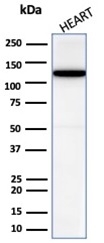
 3
3