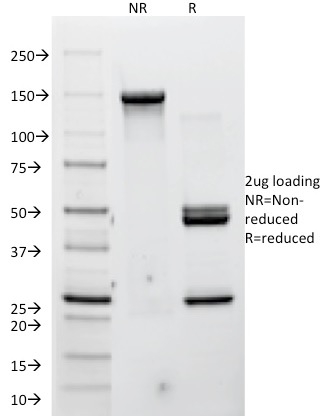
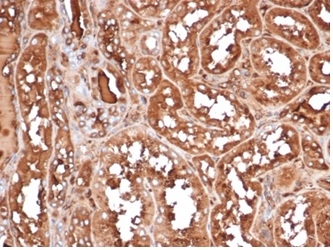
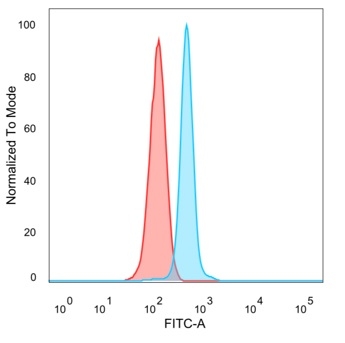
Expressed at highest levels in lung, and at lower levels in placenta, liver, kidney, spleen, and peripheral blood
Immunogen
Recombinant human BATF protein
Purification
Protein A
Storage & Stability
Antibody with azide - store at 2 to 8 °C. Antibody without azide - store at -20 to -80 °C. Antibody is stable for 24 months. Non-hazardous. No MSDS required.
Supplied as
200ug/ml of Ab purified from Bioreactor Concentrate by Protein A. Prepared in 10mM PBS with 0.05% BSA & 0.05% azide. Also available WITHOUT BSA & azide at 1.0mg/ml.
Limitations
This antibody is available for research use only and is not approved for use in diagnosis.
AP-1 family transcription factor that controls the differentiation of lineage-specific cells in the immune system: specifically mediates the differentiation of T-helper 17 cells (Th17), follicular T-helper cells (TfH), CD8(+) dendritic cells and class-switch recombination (CSR) in B-cells. Acts via the formation of a heterodimer with JUNB that recognizes and binds DNA sequence 5'-TGA[CG]TCA-3'. The BATF-JUNB heterodimer also forms a complex with IRF4 (or IRF8) in immune cells, leading to recognition of AICE sequence (5'-TGAnTCA/GAAA-3'), an immune-specific regulatory element, followed by cooperative binding of BATF and IRF4 (or IRF8) and activation of genes. Controls differentiation of T-helper cells producing interleukin-17 (Th17 cells) by binding to Th17-associated gene promoters: regulates expression of the transcription factor RORC itself and RORC target genes such as IL17 (IL17A or IL17B). Also involved in differentiation of follicular T-helper cells (TfH) by directing expression of BCL6 and MAF. In B-cells, involved in class-switch recombination (CSR) by controlling the expression of both AICDA and of germline transcripts of the intervening heavy-chain region and constant heavy-chain region (I(H)-C(H)). Following infection, can participate in CD8(+) dendritic cell differentiation via interaction with IRF4 and IRF8 to mediate cooperative gene activation. Regulates effector CD8(+) T-cell differentiation by regulating expression of SIRT1. Following DNA damage, part of a differentiation checkpoint that limits self-renewal of hematopoietic stem cells (HSCs): up-regulated by STAT3, leading to differentiation of HSCs, thereby restricting self-renewal of HSCs (By similarity).
There are no warranties, expressed or implied, which extend beyond this description. Company is not liable for any personal injury or economic loss resulting from this product.
AP-1 family transcription factor that controls the differentiation of lineage-specific cells in the immune system: specifically mediates the differentiation of T-helper 17 cells (Th17), follicular T-helper cells (TfH), CD8(+) dendritic cells and class-switch recombination (CSR) in B-cells. Acts via the formation of a heterodimer with JUNB that recognizes and binds DNA sequence 5′-TGA[CG]TCA-3′. The BATF-JUNB heterodimer also forms a complex with IRF4 (or IRF8) in immune cells, leading to recognition of AICE sequence (5′-TGAnTCA/GAAA-3′), an immune-specific regulatory element, followed by cooperative binding of BATF and IRF4 (or IRF8) and activation of genes. Controls differentiation of T-helper cells producing interleukin-17 (Th17 cells) by binding to Th17-associated gene promoters: regulates expression of the transcription factor RORC itself and RORC target genes such as IL17 (IL17A or IL17B). Also involved in differentiation of follicular T-helper cells (TfH) by directing expression of BCL6 and MAF. In B-cells, involved in class-switch recombination (CSR) by controlling the expression of both AICDA and of germline transcripts of the intervening heavy-chain region and constant heavy-chain region (I(H)-C(H)). Following infection, can participate in CD8(+) dendritic cell differentiation via interaction with IRF4 and IRF8 to mediate cooperative gene activation. Regulates effector CD8(+) T-cell differentiation by regulating expression of SIRT1. Following DNA damage, part of a differentiation checkpoint that limits self-renewal of hematopoietic stem cells (HSCs): up-regulated by STAT3, leading to differentiation of HSCs, thereby restricting self-renewal of HSCs (By similarity).
Worry-Free Guarantee
Should a NeoBiotechnologies antibody not meet the experimental expectations outlined on our website or datasheet, please contact our Technical Support. We unconditionally guarantee our product.







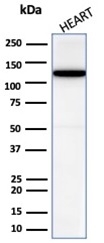
 3
3