| Catalog Number: | 4035-RBM7 |
|---|---|
| Gene: | |
| Host: | |
| Reactivity: | Guinea Pig, Human, Mouse, Rabbit, Rat |
Trial Size Available
Carrier-Free Available

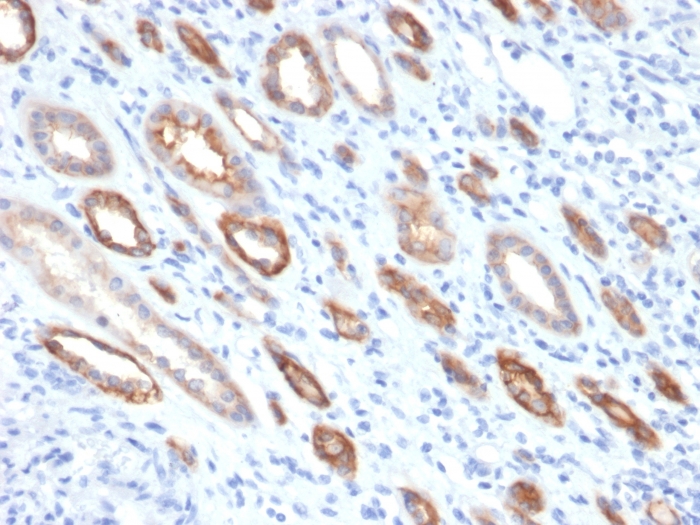
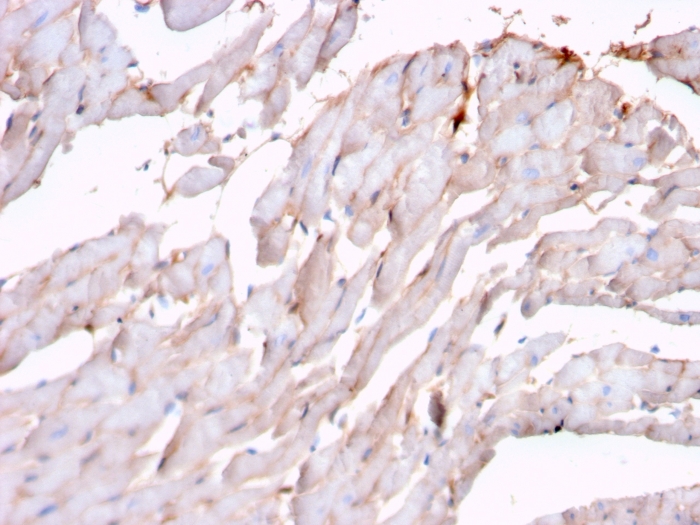
Formalin-fixed, paraffin-embedded human kidney stained with CD91 / LRP1 Recombinant Rabbit Monoclonal Antibody (LRP1/8947R) Inset: PBS instead of primary antibody; secondary only negative control.

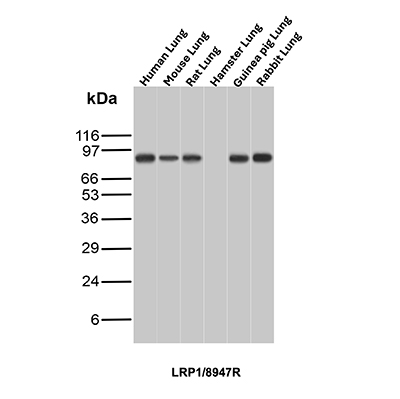
SDS-PAGE Analysis of Purified CD91 Recombinant Rabbit Monoclonal Antibody (LRP1/8947R). Confirmation of Purity and Integrity of Antibody.
| Document Name | |
|---|---|
| Datasheet | Download Here |
| Material Safety Data Sheet | Download Here |
| Applications | Tested Dilutions | Protocol | Note |
|---|---|---|---|
| Immunohistochemistry (IHC) | 1-2ug/ml | IHC Protocol | 30 min at RT. Staining of formalin-fixed tissues requires heating tissue sections in 10mM Tris with 1mM EDTA, pH 9.0, for 45 min at 95°C followed by cooling at RT for 20 minutes |
| Western Blot (WB) | 2-4ug/ml | Western Blot Protocol |
Members of the LDL receptor gene family, including LDLR (low density lipoprotein receptor), LEP1 (low density lipoprotein related protein), megalin (also designated GP330), VLDLR (very low density lipoprotein receptor) and apoER2 are characterized by a cluster of cysteine-rich class A repeats, epidermal growth factor (EGF)-like repeats, YWTD repeats and an O-linked sugar domain. LRP1, also designated LRP and α-2-Macroglobulin receptor, is an endocytic receptor that mediates the uptake of at least 15 ligands, including α-2-Macroglobulin and apoE. LRP1 is cleaved into a membrane subunit and an extracellular subunit, which remain non-covalently associated. Proper folding and trafficking of LRP1 is facilitated by the receptor-associated protein (RAP), a molecular chaperone. The uptake of all known ligands through LRP1 can be blocked by RAP, which induces a conformational change in the receptor that renders it unable to bind ligands. LRP1, which is expressed in brain, liver and lung, is also implicated in Alzheimer s disease (AD), as the human LRP gene localizes to a potential AD locus on chromosome 12.
Should a NeoBiotechnologies antibody not meet the experimental expectations outlined on our website or datasheet, please contact our Technical Support. We unconditionally guarantee our product.
Our team of scientists are ready to help you with expert recommendations or technical assistance related to applications or product use.
Information
© 2026 NeoBiotechnologies.  All Rights Reserved.
Monday-Friday: 8:00am – 8:00pm Pacific Time