
PARTNERSHIP OPPORTUNITIES


Flow cytometric analysis of PFA-fixed HeLa cells. USF2 Mouse Monoclonal Antibody (PCRP-USF2-1A7) followed by goat anti-mouse IgG-CF488 (blue); unstained cells (red).

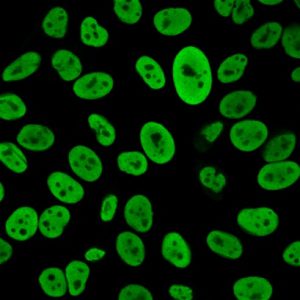
Immunofluorescence Analysis of PFA-fixed HeLa cells stained using USF2 Mouse Monoclonal Antibody (PCRP-USF2-1A7) followed by goat anti-mouse IgG-CF488 (green). CF640R phalloidin (red).

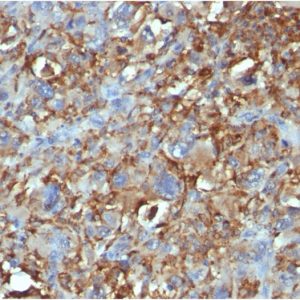
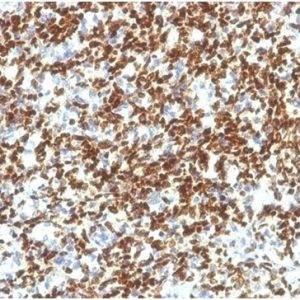
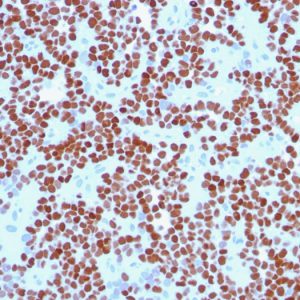
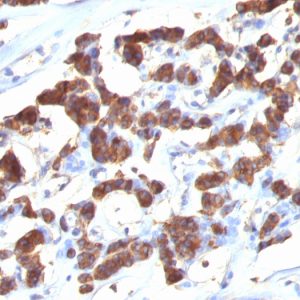
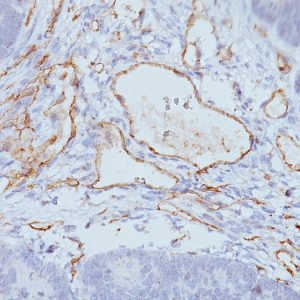
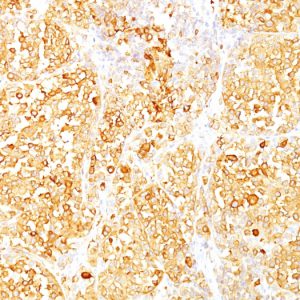
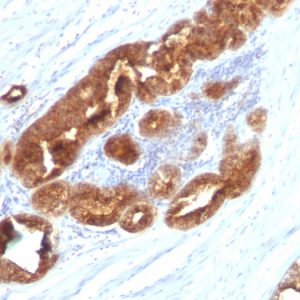
Formalin-fixed, paraffin-embedded human colon cancer stained with USF2 Mouse Monoclonal Antibody (PCRP-USF2-1A7). Inset: PBS instead of primary antibody; secondary only negative control.

Analysis of Protein Array containing more than 19,000 full-length human proteins using USF2 Mouse Monoclonal Antibody (PCRP-USF2-1A7). Z- and S- Score: The Z-score represents the strength of a signal that a monoclonal antibody (MAb) (in combination with a fluorescently-tagged anti-IgG secondary antibody) produces when binding to a particular protein on the HuProtTM array. Z-scores are described in units of standard deviations (SD's) above the mean value of all signals generated on that array. If targets on HuProtTM are arranged in descending order of the Z-score, the S-score is the difference (also in units of SD's) between the Z-score. S-score therefore represents the relative target specificity of a MAb to its intended target. A MAb is considered to specific to its intended target, if the MAb has an S-score of at least 2.5. For example, if a MAb binds to protein X with a Z-score of 43 and to protein Y with a Z-score of 14, then the S-score for the binding of that MAb to protein X is equal to 29.

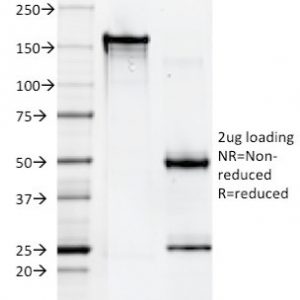
SDS-PAGE Analysis of Purified SMARCA4 Rabbit Recombinant Monoclonal Antibody (PCRP-USF2-1A7). Confirmation of Purity and Integrity of Antibody.
The ubiquitously expressed cellular upstream stimulatory factor (USF) consists of USF-1 and USF-2 polypeptides which independently exhibit site-specific DNA binding and are members of the c-Myc-related family of regulatory factors containing helix-loop-helix domains. USF also contains a leucine repeat that is required for efficient DNA binding. USF was originally identified as an upstream stimulatory factor that binds the core sequence CACGTG in the adenovirus late promoter. These findings, together with the demonstration of cooperative interaction between USF and the initiatorbinding protein, TFII-I, raises the possibility of a more general involvement of USF in transcriptional regulation. While expression of both USF-1 and USF-2 species is ubiquitous, different ratios of USF homo- and heterodimers are found in different cell types.


There are no reviews yet.